

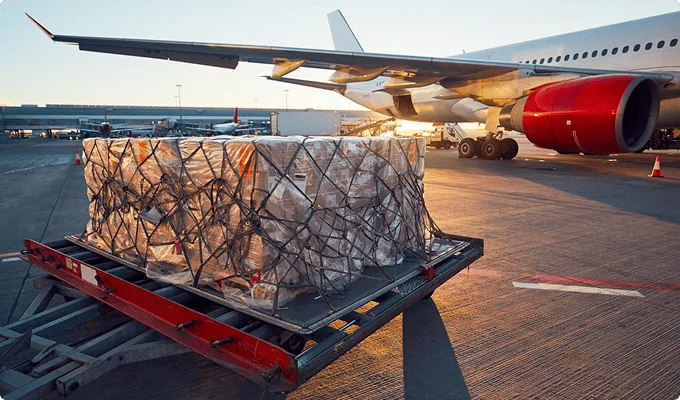

Shipping commercial freight from the United States to Kyrgyzstan usually involves either air transportation or a multimodal route combining ocean freight with rail and road service. Kyrgyzstan has no seaport, so a container cannot move directly from a U.S. port to Bishkek or another Kyrgyz destination.
For large shipments, machinery, equipment, commercial inventory, and palletized cargo, ocean freight can still cover the longest part of the journey. The container is discharged at a foreign port and then continues inland through one or more countries. Air freight removes most of those transfers and is used for urgent parts, electronics, medical goods, samples, and higher-value cargo.
RAM International Shipping works as a freight forwarder. RAM does not operate the ocean vessels, aircraft, trains, or long-haul trucks used on the route. For ocean freight, RAM is a licensed NVOCC and arranges transportation with vessel-operating carriers. For air cargo, RAM works as an IATA-licensed agent and coordinates shipments through airline agreements.
Ocean Freight from USA to Kyrgyzstan Requires a Multimodal Route
Because Kyrgyzstan is landlocked, ocean freight always needs an inland connection after the maritime leg.
Several routing patterns are used in the market. Some services move containers through Black Sea gateways such as Poti in Georgia and continue toward Central Asia by road, rail, Caspian ferry, or a combination of these modes. Other routings use Asian ports and onward connections through China or Kazakhstan. Current freight providers serving the USA–Kyrgyzstan market offer both types of multimodal arrangements.
The route used for an actual shipment depends on the U.S. origin, available carrier service, commodity, equipment, border conditions, and final destination in Kyrgyzstan. A route suitable for a standard container going to Bishkek may not be suitable for oversized machinery or cargo destined for Osh.
Comparing only the ocean portion can therefore give a misleading picture of the shipment. Port handling, rail or trucking, transloading, border procedures, and transportation inside Kyrgyzstan can account for a significant part of the schedule and final cost.
RAM coordinates the individual transport legs with the companies operating them rather than presenting the ocean carrier as if it delivered directly to Kyrgyzstan.
FCL, LCL and Ground Freight to Kyrgyzstan
Full Container Load is commonly used for machinery, several pallets, commercial stock, industrial materials, vehicles, and other larger loads. One shipper uses the complete container, and the cargo may remain in the same unit through several stages of the route where operational arrangements allow it.
Less than Container Load works for smaller commercial shipments. Cargo from different shippers shares container space and is consolidated before the international movement and separated later in the route.
LCL involves more handling than FCL. On a shipment to Kyrgyzstan, that difference can be more noticeable because the route may already include transfers between ocean, rail, and road services.
Ground freight is a normal part of many Kyrgyzstan routes rather than an extra service added simply for final delivery. Kyrgyzstan borders Kazakhstan, China, Uzbekistan, and Tajikistan, and international cargo can approach the country through different border corridors depending on the selected route.
After entering Kyrgyzstan, trucking is commonly needed for delivery to Bishkek, Osh, Jalal-Abad, Karakol, or industrial facilities outside the main cities.
Large machinery needs additional planning. Cargo that cannot fit into a standard dry container may require an open-top container, flat rack, breakbulk handling, or project-cargo arrangement. Once it moves by road, dimensions and gross weight can also determine the trailer type and route that can be used.
RAM coordinates FCL, LCL, project cargo, oversized freight, packing, crating, warehousing, and transloading with the service providers handling each part of the shipment.
Air Freight from USA to Kyrgyzstan Through Bishkek
Air freight gives shippers a more direct route into Kyrgyzstan and avoids most of the maritime, rail, and border transfers involved in an ocean-based shipment.
Manas International Airport near Bishkek has a dedicated air cargo terminal operating 24/7. The airport lists annual cargo-terminal capacity of 100,000 tonnes and facilities for general, perishable, dangerous, valuable, and live-animal cargo. Refrigerated and freezer storage is also available.
The terminal states that its handling equipment can service aircraft such as the Boeing 747-400, AN-124, and IL-76, including simultaneous loading or unloading of two aircraft of these types.
Official terminal information is available here:
Manas International Airport — Air Cargo Terminal
Air freight is commonly used for replacement components, electronics, pharmaceuticals, medical equipment, samples, production materials, and other goods that cannot wait for a multimodal ocean route.
Rates are based largely on chargeable weight. Airlines compare actual gross weight with volumetric weight, so a bulky but relatively light shipment can be charged at a higher weight than its scale reading.
Individual piece dimensions must also be checked before booking. Long crates, heavy industrial parts, lithium batteries, dangerous goods, pharmaceuticals, perishables, and temperature-sensitive cargo can require additional documentation, packaging, or airline approval.
RAM coordinates these shipments through airline agreements rather than operating aircraft itself.
Kyrgyzstan Customs Clearance and EAEU Import Rules
Kyrgyzstan became a full member of the Eurasian Economic Union in August 2015. Imports from the United States are therefore handled under Kyrgyz national legislation together with the EAEU customs framework. The EAEU Customs Code has been in force since January 1, 2018.
The national customs authority is the State Customs Service under the Cabinet of Ministers of the Kyrgyz Republic. Its current official site provides customs information, services, legal references, and customs-payment tools.
Kyrgyz Republic State Customs Service
Commercial goods require a customs declaration and supporting records appropriate to the commodity and transaction. Under EAEU rules, Customs can request documents supporting information declared for the shipment, including its classification, value, origin, and transport details. An official Russian translation of documentation can also be requested at Kyrgyz customs points.
The importer or customs broker should confirm the document set against the actual product before departure.
Import duties are based on the EAEU Unified Customs Tariff and the commodity classification. Rates vary by tariff line and can be ad valorem, specific, or combined rather than one fixed percentage for all imports.
Kyrgyzstan’s standard VAT rate is 12%, including for taxable imports. Zero-rated treatment or exemptions apply in specified cases.
EAC Conformity, Restricted Goods and Product Checks
Products covered by EAEU technical regulations can require conformity assessment before they are placed on the Kyrgyz market.
Depending on the applicable technical regulation, this can involve a declaration or certificate of conformity and other marking or documentation requirements. KyrgyzStandard registers declarations of conformity under EAEU technical regulations for many product groups.
Machinery, electrical equipment, consumer products, food, children’s goods, and other regulated categories may fall under these rules. Requirements should be checked against the exact product and applicable technical regulation rather than a broad description such as “equipment” or “electronics.”
Most goods can be imported freely, but several categories require licenses or special permits. Current trade guidance identifies pharmaceuticals, alcohol, tobacco, weapons, and certain chemicals among the products subject to additional controls.
Prohibited imports include narcotics, weapons of mass destruction, pornography, and other goods restricted under Kyrgyz and EAEU legislation.
Military and dual-use products need a separate check. Kyrgyzstan has tightened import controls for goods on its national control list, and such products can require authorization before import.
Carrier acceptance does not replace this regulatory review. A shipping line, airline, or freight forwarder can accept cargo for transportation while the importer still needs a license, conformity document, or other authorization for customs release.
Shipping Cost and Transit Time from USA to Kyrgyzstan
Freight rates to Kyrgyzstan vary more than on a simple port-to-port route because several transport modes can be involved in one shipment.
For an ocean-based movement, the cost can include U.S. origin services, ocean freight, terminal handling at the transit port, rail or road transportation, border-related services, transloading where needed, and delivery inside Kyrgyzstan.
FCL and LCL also have different cost structures. LCL avoids paying for an entire container, but consolidation and deconsolidation add handling. Machinery and oversized cargo can require specialized containers, lifting equipment, trailers, or terminal services.
Air freight is affected more heavily by chargeable weight, individual dimensions, airline capacity, routing, commodity, and urgency.
RAM’s Freight Rate Calculator can be used with the actual origin, destination, cargo weight, dimensions, and transport mode.
Transit time should be treated as route-specific. Ocean and multimodal shipments can be affected by vessel schedules, transshipment, rail connections, border processing, road conditions, and consolidation. Air freight is faster, but connections, cargo handling, customs clearance, and release still need to be included in the complete schedule.
For a commercial shipment, the useful estimate is the one built around the actual cargo-ready date and selected routing rather than a fixed USA-to-Kyrgyzstan number.
RAM coordinates the carrier bookings and supporting logistics as the freight forwarder.
For a quote, provide the commodity, number of pieces or pallets, exact dimensions, gross weight, U.S. origin, final destination in Kyrgyzstan, and cargo-ready date.
Machinery, vehicles, batteries, dangerous goods, pharmaceuticals, temperature-sensitive cargo, oversized equipment, and products covered by EAEU technical regulations require additional information before routing is confirmed.
The Kyrgyz importer should also check the HS classification, customs documentation, applicable duties and VAT, conformity requirements, and any product-specific licenses or permits.
Request a quote for shipping from the USA to Kyrgyzstan based on your cargo, origin, destination, and required delivery schedule.