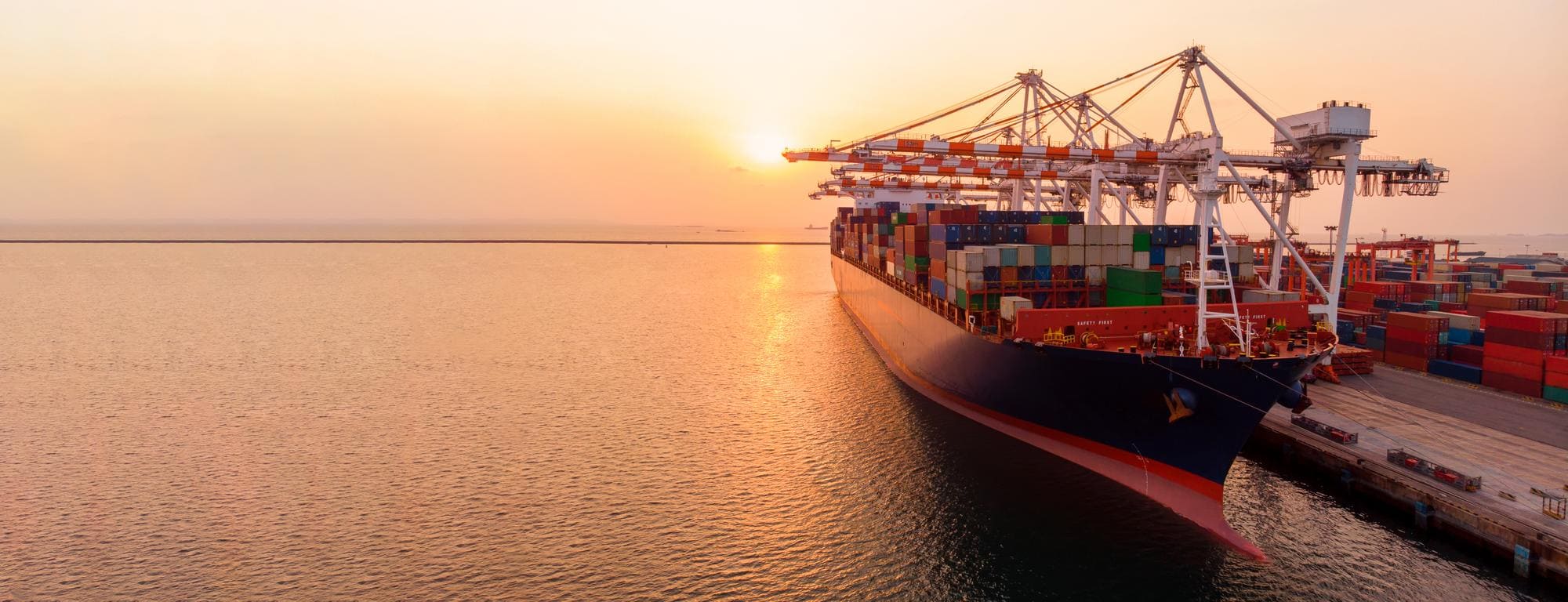

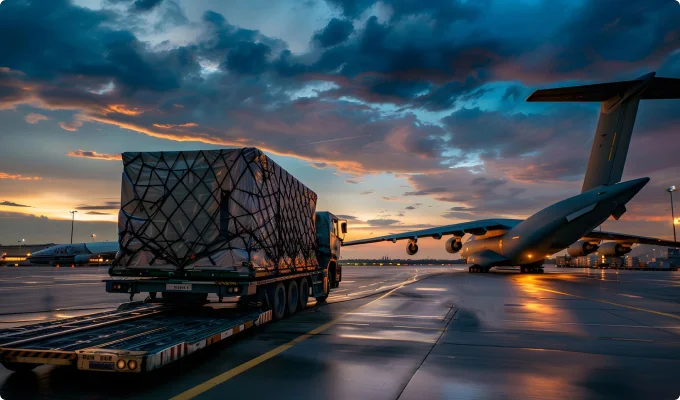
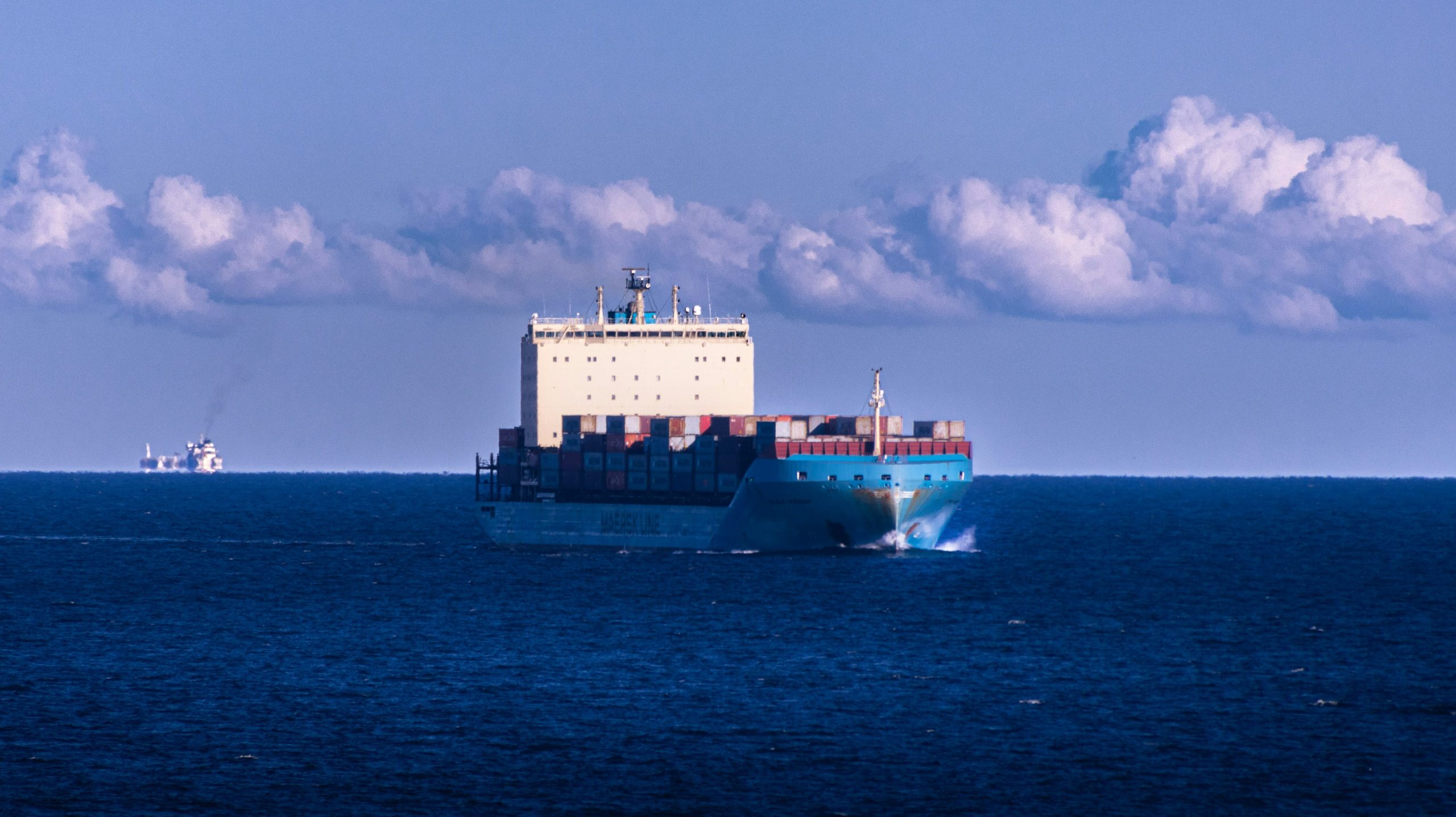
Freight from the United States to Japan moves through a well-developed network of container ports and international cargo airports. For commercial shipments, ocean freight and air freight cover most requirements, from several pallets of inventory to industrial machinery and urgent replacement parts.
Ocean freight is commonly used for machinery, commercial stock, automotive cargo, industrial equipment, raw materials, and other larger loads. Full Container Load (FCL) gives one shipper the use of a complete container, while Less than Container Load (LCL) allows smaller shipments to share container space.
Air freight serves a different type of shipment: urgent components, electronics, medical products, samples, high-value cargo, and goods tied to production or sales deadlines.
RAM International Shipping works as a freight forwarder. It does not operate the ocean vessel or aircraft carrying the international shipment. RAM is a licensed NVOCC for ocean freight and coordinates bookings with vessel-operating carriers. Its air freight operation is an IATA-licensed agent with agreements covering more than 60 airlines.
Choosing a Port for Ocean Freight from USA to Japan
Japan has several large commercial ports, and using the best-known port is not always the most sensible routing.
Yokohama is one of the main gateways serving the Tokyo metropolitan area and eastern Japan. The port handles containers, automobiles, energy products, grain, and other cargo. Its international network includes more than 90 regular container shipping routes.
Container facilities at Yokohama include Honmoku and Minami-Honmoku. Minami-Honmoku has deep-water container berths built for large vessels, while Daikoku Pier has extensive facilities for automobiles and RoRo traffic.
Nagoya has a different cargo profile. The official port authority reports that it was Japan’s largest port by total cargo throughput in 2024, handling 156.71 million tonnes. The surrounding region is a major center for automobile manufacturing, and Nagoya is Japan’s largest automobile export port by completed vehicle volume.
Its container infrastructure consists of five terminal areas with 13 container berths. Some terminals also have direct North America West Coast services.
Tokyo, Osaka, and Kobe are also common freight gateways. Current companies competing for USA-to-Japan freight searches typically offer several Japanese ports rather than routing everything through Tokyo or Yokohama.
FCL is normally used for larger orders, multiple pallets, machinery, or freight that needs a full container. LCL works for smaller loads but adds consolidation before departure and deconsolidation after arrival.
Machinery that exceeds standard container dimensions may need a flat rack, open-top container, breakbulk service, or another project-cargo arrangement. Vehicles and suitable wheeled equipment may also move by RoRo where carrier service is available on the required port pair.
RAM coordinates FCL, LCL, RoRo, project, and oversized cargo with ocean carriers. Packing, crating, consolidation, warehousing, and transloading can also be arranged when required before export.
Air Freight from USA to Japan via Narita and Kansai
For shipments measured in days rather than weeks, air freight is usually the mode to price first.
Narita International Airport is a major Japanese cargo gateway. Narita International Airport Corporation reports approximately 233,000 square meters of cargo warehouse area, with additional freight-forwarding and logistics facilities located around the airport.
Kansai International Airport serves western Japan and has a substantial dedicated cargo operation. Its international cargo facilities were designed with capacity of 900,000 tonnes per year at opening and up to 1.4 million tonnes at full development. Kansai Airports is also carrying out its Cargo Next modernization program to expand and update the international cargo area.
Air freight rates are calculated primarily from chargeable weight. Airlines compare gross weight with volumetric weight, so a large lightweight crate may be billed at a substantially higher weight than the number shown on a scale.
Individual dimensions have to be checked as well. Heavy machinery, long crates, or unusual pieces must fit the aircraft and loading equipment used on the booked service.
Lithium batteries, dangerous goods, pharmaceuticals, perishables, high-value products, and temperature-sensitive freight can require additional packaging, documentation, or airline approval.
RAM arranges standard air freight, consolidations, time-critical shipments, charters, dangerous goods, pharmaceutical and temperature-sensitive cargo, and oversized freight through its airline agreements rather than operating aircraft itself.
Japan Customs Clearance, NACCS and Import Documents
Goods entering Japan must be declared to Customs and receive an import permit before release.
Japan Customs states that an import declaration is generally submitted after the goods have entered a bonded area or another designated location. The importer files the declaration directly or has a customs broker act on its behalf.
Japan uses NACCS — Nippon Automated Cargo and Port Consolidated System for electronic customs processing. Import declarations can be filed through NACCS, which handles a large part of Japan’s electronic customs procedures.
Japan Customs lists the following among the documents that may be required with an import declaration:
- commercial invoice;
- bill of lading or air waybill;
- certificate or evidence of origin where applicable;
- packing list;
- freight account;
- insurance certificate;
- permits or approvals required by other Japanese laws.
The exact file depends on the product and transaction.
For official guidance, Japan Customs maintains its import procedure information here: Japan Customs — Import Procedures
HS classification should be settled before shipping whenever possible. The tariff classification affects the customs duty rate and may also identify regulations administered by another Japanese authority.
Imported goods are generally subject to customs duty where applicable and Japanese consumption tax. The current standard consumption tax rate is 10%, with an 8% reduced rate applying to specified goods. The customs duty itself varies by tariff classification and the tariff treatment available to the product.
Japan Customs also provides advance classification rulings for importers that need greater certainty about a product’s tariff classification before import.
U.S.–Japan Trade Agreement and Regulated Cargo
The U.S.–Japan Trade Agreement entered into force on January 1, 2020, but it should not be described as a blanket free-trade agreement covering every shipment from the United States.
The agreement provides tariff reductions or elimination for specified goods. Its strongest market-access provisions apply to a range of agricultural and food products, while only selected industrial tariff lines are covered.
Preferential treatment is tied to the product and its origin, not simply to the port where the cargo was loaded.
Japan Customs includes the U.S.–Japan Trade Agreement among agreements using a self-certification procedure. An importer, exporter, or producer can prepare the applicable origin certification document when the goods satisfy the agreement’s rules of origin. The importer remains responsible for supporting a preferential tariff claim.
Food imports have a separate regulatory process.
Under Japan’s Food Sanitation Act, businesses importing food, food additives, certain apparatus, containers, or packaging for sale or business use must submit an import notification to the Ministry of Health, Labour and Welfare. A quarantine station reviews the notification and determines whether additional inspection is required.
The current official procedure is available through: MHLW — Import Procedure under the Food Sanitation Act
Plants and plant products fall under Japan’s plant quarantine rules. The requirements depend on the commodity and country of origin. Many plants require a phytosanitary certificate issued by the exporting country’s plant-protection authority and inspection when they enter Japan, while some plants are prohibited or subject to additional phytosanitary measures.
Japan’s official Plant Protection Station provides current requirements here: Japan Plant Protection Station — Import Regulations
For food, plants, chemicals, pharmaceuticals, medical devices, and other regulated cargo, the Japanese importer should check the commodity-specific rules before the shipment leaves the United States.
Carrier acceptance and import approval are separate matters. A booking with an airline or shipping line does not by itself confirm that the product meets Japanese import requirements.
Shipping Cost and Transit Time from USA to Japan
Cost and transit time are prominent on current pages ranking for USA-to-Japan freight searches, so they are worth covering on this destination page.
Competitors currently publish ocean transit estimates as short as roughly 14–21 days for some U.S. West Coast-to-Japan FCL routes, with considerably longer schedules from East Coast or Gulf origins. Air freight estimates are generally measured in days instead of weeks. These figures are useful for initial planning but should not be treated as fixed carrier schedules.
For ocean freight, price is affected by the U.S. origin, export port, FCL or LCL service, Japanese port, container type, cargo volume and weight, equipment requirements, and current carrier pricing.
Air freight reacts more heavily to chargeable weight, dimensions, airport pair, available capacity, commodity, and priority level.
RAM’s rate tool can be used with the actual cargo and route information rather than a general country-to-country estimate: Freight Rate Calculator
International freight is not necessarily the entire logistics bill. Packing, warehouse handling, terminal fees, insurance, customs services, duties and taxes, storage, specialized equipment, and destination charges may be quoted separately.
LCL also needs time for consolidation and deconsolidation. Air shipments may use connecting flights, and ocean cargo can use direct or transshipment services depending on the carrier and port pair.
For freight tied to a fixed production date, event, or inventory deadline, the current vessel or flight schedule should be checked once the cargo-ready date is known.
Freight Forwarding from USA to Japan with RAM International Shipping
RAM International Shipping coordinates the carrier booking and the services around the international movement.
For ocean freight, RAM operates as a licensed NVOCC and books FCL, LCL, RoRo, project, and oversized cargo with vessel-operating carriers. As an NVOCC, RAM can issue its own bills of lading.
For air freight, RAM works as an IATA-licensed agent and books cargo through its airline network. The current service includes regular air freight, consolidations, urgent shipments, charters, dangerous goods, temperature-sensitive cargo, and oversized pieces.
Vehicles and machinery need accurate dimensions and weights. Batteries and dangerous goods require technical documentation. Food, plant products, pharmaceuticals, and other regulated cargo should be checked against Japanese import rules before the booking is finalized.
If preferential tariff treatment under the U.S.–Japan Trade Agreement may apply, the importer should also confirm the HS code, origin rule, and required origin documentation.
Request a quote for shipping from the USA to Japan based on your cargo, origin, destination, and required delivery schedule.