

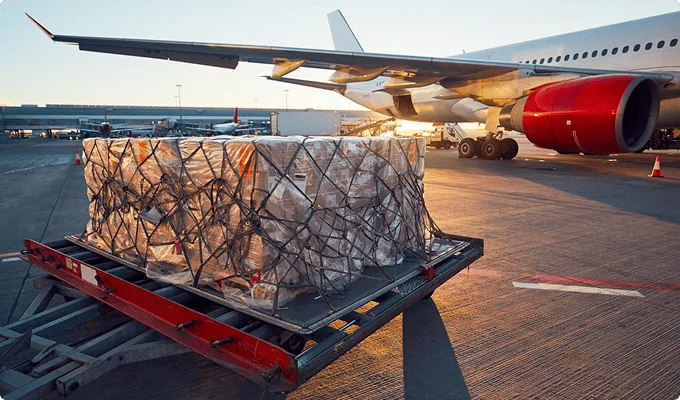

Commercial freight from the United States to Israel usually moves by ocean through Haifa or Ashdod, or by air through Ben Gurion International Airport. The route depends on the cargo, U.S. origin, final destination in Israel, and how quickly the shipment needs to arrive.
Ocean freight is commonly used for machinery, vehicles, industrial equipment, commercial inventory, pallets, and other larger loads. Full Container Load (FCL) and Less than Container Load (LCL) are available for containerized cargo, while specialized equipment can be arranged for freight that does not fit a standard container.
Air freight is used for urgent parts, electronics, medical equipment, pharmaceuticals, samples, high-value products, and other time-sensitive shipments.
RAM International Shipping works as a freight forwarder rather than the vessel-operating ocean carrier or airline. For ocean freight, RAM is a licensed NVOCC and books cargo with ocean carriers. For air freight, RAM is an IATA-licensed agent and coordinates transportation through airline agreements.
Ocean Freight from USA to Israel Through Haifa and Ashdod
Haifa and Ashdod are the two main ports to compare for containerized freight from the United States.
Haifa handles containers, general cargo, and other commercial freight in northern Israel. Its port infrastructure serves both international shipping and cargo moving to industrial and commercial areas in the north and center of the country. The official Haifa Port customer portal provides vessel schedules, container status, operating information, and cargo services.
Ashdod is located about 40 kilometers from Tel Aviv and has direct access to major transport routes serving central and southern Israel. The port handles containers as well as general and specialized cargo, and its facilities include container storage and cargo-handling infrastructure.
Port selection should follow the actual shipment rather than simply choosing Haifa or Ashdod by default. The U.S. departure port, carrier schedule, container availability, final delivery city, and cargo type can all change which route is practical.
FCL is normally used when a shipper needs the complete container. Multiple pallets, machinery, vehicles, industrial materials, and larger commercial orders are typical examples.
LCL allows smaller shipments to share container space. It can work well for several pallets or crates, but the cargo must be consolidated before departure and separated again after arrival. Those additional handling stages can affect the overall schedule.
Competitors serving the USA–Israel lane also prominently offer FCL, LCL, vehicles, machinery, and consolidated ocean freight, reflecting the main commercial search demand for this route.
Cargo that cannot fit inside a standard container may require a flat rack, open top, breakbulk arrangement, or RoRo service for suitable wheeled equipment. The available option depends on the cargo dimensions and the carrier service operating on the selected route.
Air Freight from USA to Israel Through Ben Gurion Airport
For urgent shipments, air freight removes the long ocean leg from the schedule.
Ben Gurion International Airport is Israel’s principal international air cargo gateway. Israel Airports Authority reports substantial incoming and outgoing freight activity there, including cargo carried on dedicated freighter aircraft and passenger airlines.
Air freight is commonly used for replacement parts, electronics, pharmaceuticals, medical equipment, samples, production components, and valuable cargo.
Pricing is based largely on chargeable weight. Airlines compare actual gross weight with volumetric weight, so a lightweight but bulky shipment can be charged at a higher weight than its scale reading.
Piece dimensions also need to be checked before booking. A crate may be within the airline’s weight limit but still be too large for the aircraft door or available cargo-handling equipment.
Lithium batteries, dangerous goods, pharmaceuticals, temperature-sensitive cargo, and oversized pieces may require additional documents, packaging, or airline approval.
RAM coordinates these shipments through its airline network rather than operating aircraft. Its air freight service includes standard and consolidated freight, time-critical shipments, charter arrangements, dangerous-goods support, temperature-sensitive handling, packing, and crating.
U.S.–Israel FTA and Customs Treatment of American Goods
One point that makes the USA–Israel route different from many other destination pages is the U.S.–Israel Free Trade Agreement.
The agreement entered into force in 1985 and was the United States’ first FTA. Most tariffs between the two countries have since been eliminated, although agricultural products remain subject to some tariff and non-tariff restrictions.
Zero-duty treatment is not based simply on the fact that cargo was shipped from a U.S. port. The goods must meet the FTA’s applicable rules of origin.
There is also a specific documentation requirement.
Since 2018, Israel no longer uses the old U.S.–Israel FTA Certificate of Origin for U.S. exports. U.S. Customs and Border Protection states that it was replaced by an invoice declaration. To claim preferential treatment, the exporter provides the required declaration confirming that the goods covered by the invoice meet the agreement’s origin requirements.
Goods merely purchased in the United States do not automatically qualify as U.S.-origin goods under the FTA. Exporters should verify origin before signing the declaration.
This is worth resolving before departure, especially when the shipment contains products manufactured in several countries or U.S.-assembled goods made from imported components.
Israel Customs, HS Classification and Import Requirements
Correct HS classification is important before cargo is shipped to Israel.
Israel’s Customs and Purchase Tax Tariff uses the Harmonized System, and classification affects duties, taxes, licenses, permits, and other conditions that can apply to the import. Israeli Customs also provides a commercial pre-ruling service for companies that want a classification decision before importing. The official service identifies the product using an eight-digit customs classification, and the ruling is valid for one year.
The Israeli importer and customs broker should also check whether the goods fall under the country’s Free Import Order or another product-specific regulation.
Israel’s Ministry of Economy explains that the Free Import Order brings together many of the technical regulatory requirements applied during customs clearance. Certain goods can require a license, permit, declaration, or approval from the authority responsible for that product.
The official Israeli government Importer Guide is a useful starting point for checking commercial import rules.
Products subject to mandatory standards need particular attention. Israel has changed parts of its standards regime in recent years, including broader use of declaration-based import procedures and recognition of some foreign and European standards. The requirement still depends on the exact product and applicable regulatory track.
Food, medical products, cosmetics, chemicals, agricultural goods, telecommunications equipment, and other regulated categories can involve additional government agencies.
The commercial invoice should contain detailed shipment information. Current U.S. government guidance for Israel identifies information such as the supplier and buyer, country of origin, product description, quantities, tariff heading, package weights, unit prices, total value, shipping information, and import-license number where applicable.
It is better to resolve classification and permit questions before the cargo reaches the port or airport.
Shipping Cost and Transit Time from USA to Israel
Rate and transit-time information appears prominently across competitors ranking for USA-to-Israel shipping queries, so it is useful to cover here. Published estimates vary substantially, however, and should not be treated as fixed schedules.
For ocean freight, the rate can depend on:
- U.S. origin and departure port;
- Haifa or Ashdod as the destination;
- FCL or LCL service;
- container size and equipment;
- cargo weight and dimensions;
- carrier routing and current capacity;
- special handling for vehicles, machinery, or oversized freight.
Air freight depends more heavily on chargeable weight, dimensions, airline capacity, cargo type, urgency, and whether the routing is direct or includes a connection.
RAM’s Freight Rate Calculator can be used with the actual shipment information rather than relying on a generic USA-to-Israel price.
The international freight rate may not represent the complete shipment cost. Packing, crating, warehouse handling, terminal charges, cargo insurance, customs brokerage, duties and taxes, storage, and services after arrival may be separate.
Transit time also changes with the U.S. departure point and carrier routing. LCL requires consolidation and deconsolidation, while ocean services may involve transshipment. Air freight is much faster, but cargo acceptance, connections, customs clearance, and terminal release still add time.
Carrier schedules should be checked again when the cargo is ready to move, especially on routes where operating conditions and available services can change.
Freight Forwarding from USA to Israel with RAM
RAM International Shipping coordinates the carriers and logistics services involved in moving freight from the United States to Israel.
For ocean shipments, RAM works as a licensed NVOCC and arranges FCL, LCL, RoRo, project, and oversized cargo through vessel-operating carriers. RAM can issue its own bills of lading and also provides services such as packing, crating, warehousing, consolidation, and transloading.
For air shipments, RAM works as an IATA-licensed agent and books cargo through airline agreements.
To prepare a quote, provide the cargo description, number of pieces or pallets, exact dimensions, gross weight, U.S. origin, destination in Israel, and cargo-ready date.
Vehicles, machinery, dangerous goods, batteries, pharmaceuticals, food products, and oversized freight need additional information before booking.
For goods that may qualify under the U.S.–Israel FTA, the exporter and Israeli importer should also confirm origin eligibility and the required invoice declaration. Product classification, permits, and Israeli standards requirements should be checked before departure.
Request a quote for shipping from the USA to Israel based on your cargo, origin, destination, and required delivery schedule.