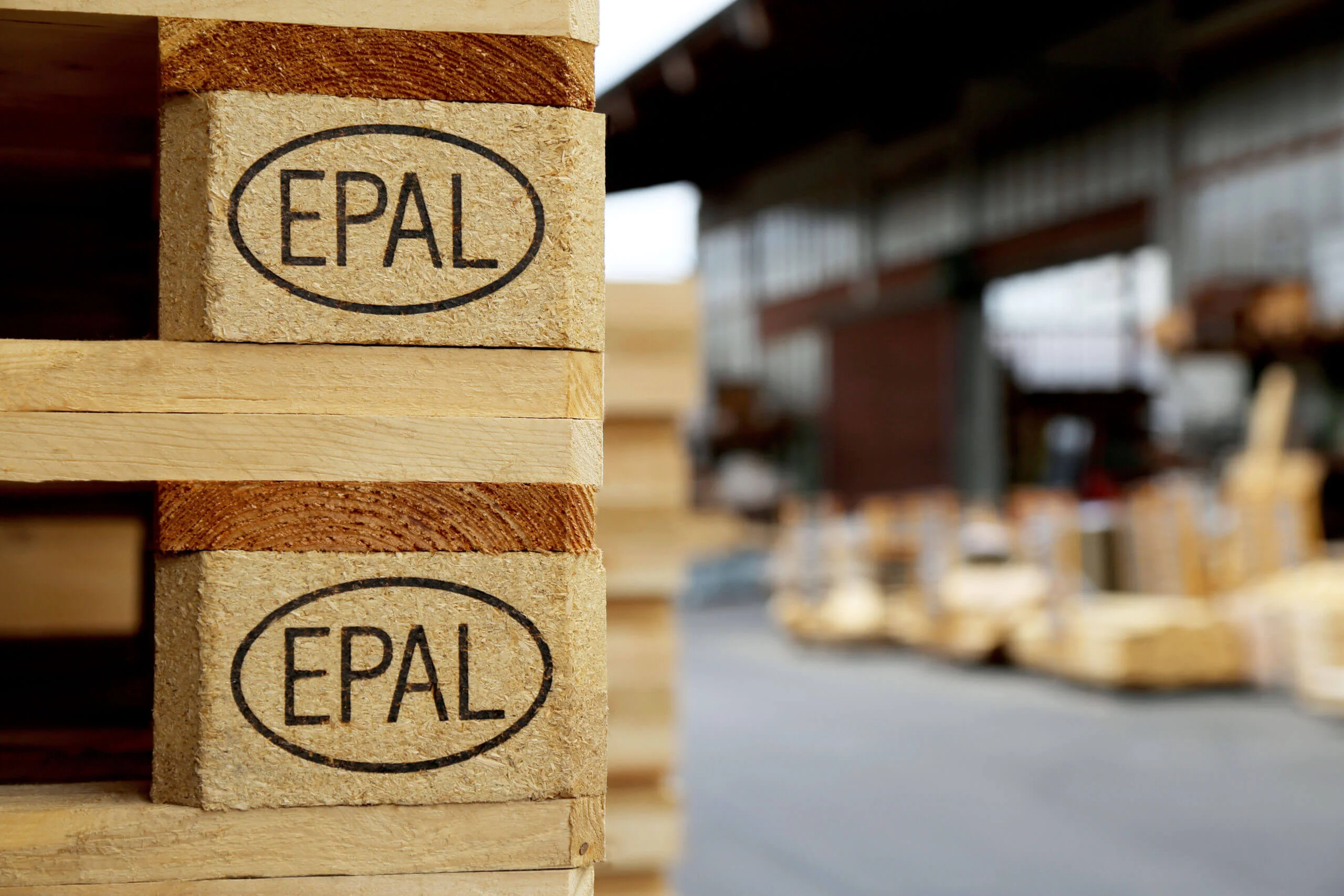
A pallet may look like a minor detail in a freight shipment, but its size can determine how goods fit inside a truck, shipping container, or warehouse rack. That matters especially when cargo moves between Europe and North America, where different pallet formats are common.
The standard Euro pallet, known as the EPAL Euro pallet or EPAL 1, measures 1,200 × 800 × 144 mm and weighs approximately 25 kg (55 lb) when empty. Those measurements are only part of the specification. Load limits, markings, wood treatment, and the condition of the pallet also matter when preparing cargo for transport.
What Is a Euro Pallet (EPAL)?
A Euro pallet is a reusable wooden platform used to store, handle, and transport goods. The standard EPAL Euro pallet is produced under the rules of the European Pallet Association (EPAL), which licenses manufacturers and repair businesses and sets requirements for construction and quality.
Its consistent size makes it practical for European distribution networks. Pallet jacks, forklifts, loading areas, and many storage systems are built to handle this footprint. The design has openings on all four sides for handling equipment, while its wooden blocks support the deck above the floor.
Not every wooden pallet measuring 1,200 × 800 mm is an EPAL pallet. The EPAL designation also requires approved construction and identification markings. That distinction becomes important if a customer specifies certified pallets or participates in a pallet exchange arrangement.
Standard Euro Pallet Dimensions in mm, cm and Inches
The dimensions of an EPAL 1 pallet are fixed by its product specification. They refer to the empty pallet itself, not the cartons or other freight loaded on top.
| Measurement | Metric | US units |
|---|---|---|
| Length | 1,200 mm / 120 cm | 47.24 in |
| Width | 800 mm / 80 cm | 31.50 in |
| Height | 144 mm / 14.4 cm | 5.67 in |
| Floor footprint | 0.96 m² | 10.33 sq ft |
| Empty pallet weight | Approx. 25 kg | Approx. 55 lb |
| Safe working load | 1,500 kg | Approx. 3,307 lb |
The footprint is useful when planning floor space. For transport bookings, however, the carrier needs the outside dimensions of the complete loaded pallet, including its packaging. A carton that extends past the deck changes the shipment’s actual dimensions and may make handling or loading more difficult.
Other EPAL Pallet Sizes: EPAL 2, EPAL 3 and EPAL 6
The familiar Euro pallet is EPAL 1, but the association also specifies other pallet formats. These should not be treated as identical products simply because they belong to the same family.
| Pallet type | Dimensions (L × W × H) | Empty weight | Safe working load |
|---|---|---|---|
| EPAL 1 Euro pallet | 1,200 × 800 × 144 mm | Approx. 25 kg | 1,500 kg |
| EPAL 2 industrial pallet | 1,200 × 1,000 × 162 mm | Approx. 35 kg | 1,250 kg |
| EPAL 3 pallet | 1,000 × 1,200 × 144 mm | Approx. 30 kg | 1,500 kg |
| EPAL 6 half pallet | 800 × 600 × 144 mm | Approx. 9.5 kg | 750 kg |
EPAL 2 has a larger deck and a base frame intended for industrial handling, including some conveyor systems. EPAL 3 has a similar floor area but a different construction and height. EPAL 6 uses half the EPAL 1 footprint and is commonly associated with retail displays. The weight rating of one type should never be applied to another.
How Much Does a Euro Pallet Weigh?
According to EPAL, an empty standard Euro pallet weighs approximately 25 kg, or 55 lb. Actual weight can vary with wood moisture and the pallet’s condition, so the published figure is best used for planning rather than as a substitute for weighing cargo.
For example, if products and packaging weigh 600 kg and the pallet weighs 25 kg, the estimated gross weight is 625 kg. Gross weight is the figure that matters for transport planning because the carrier moves the pallet as well as its contents.
This difference is particularly relevant for air freight, where both actual gross weight and shipment dimensions can affect chargeable weight.
Euro Pallet Load Capacity: Working Load vs. Stacking Load
The official safe working load for an EPAL 1 pallet is 1,500 kg. That is the appropriate figure to use when discussing its rated handling capacity. It does not mean every arrangement of heavy cargo is safe: concentrated pressure, uneven weight distribution, damage, and the way a pallet is supported all affect performance.
EPAL also publishes a separate limit for stacked, loaded pallets. When pallets are stacked on a solid, even surface, the bottom pallet must not be subjected to more than 5,500 kg of load. This is a specific stacking condition, not permission to lift a 5,500 kg load with a forklift or to place that weight on warehouse rack beams.
Some pallet guides quote general static and dynamic capacities. Those figures may be useful in other contexts, but they should not replace EPAL’s own safe working and stacking specifications. Racking limits must also be checked against the particular rack design, support arrangement, and pallet condition.
EPAL Euro Pallet Construction and Materials
The standard EPAL 1 is a wooden block pallet built from 11 boards, nine blocks, and 78 nails. The nail positions and component dimensions are specified, rather than left to individual manufacturers.
The nine-block arrangement allows entry from four sides and creates space for forklift tines and compatible pallet trucks. EPAL also sets requirements for board thickness, the placement of nails, and the shape of the lower boards. These details help pallets behave consistently when they pass through different warehouses.
Wood makes the pallet repairable, but repairs are not unrestricted. An EPAL pallet that needs structural repairs must be handled by an EPAL-licensed repair operation. A plastic pallet with the same footprint may be suitable for certain applications, but it is not an EPAL 1 wooden pallet.
EPAL Pallet Markings: How to Recognize an Authentic Pallet
A genuine EPAL pallet has identifying marks on its blocks. The EPAL brand, the manufacturer’s licence information, and the IPPC treatment mark help distinguish a certified pallet from an unmarked wooden platform.
The IPPC mark contains treatment information, including a country code and the HT designation for heat treatment. EPAL pallets also carry a control staple. If a pallet has been repaired under the EPAL system, it should have the corresponding repair marking nail.
Markings alone do not tell you whether a pallet remains usable. Broken boards, missing blocks, serious splintering, rot, or contamination can make a pallet unsuitable for exchange or transport. EPAL publishes criteria for assessing damage and requires licensed repairs when a pallet no longer meets the applicable requirements.
The terms EUR pallet and EPAL pallet are sometimes used casually as synonyms. For a shipment requiring EPAL-certified pallets, however, check the actual identification and condition rather than relying on the seller’s description.
Are Euro Pallets Heat Treated for International Shipping?
International movements of wooden packaging can be subject to ISPM 15, the plant-health standard intended to reduce the spread of pests through wood packaging material. It is especially relevant when pallets cross borders into countries that apply those import requirements.
EPAL states that newly manufactured EPAL Euro pallets have been heat treated under ISPM 15 since 2010. Its treatment process requires the wood’s core to reach at least 56°C (132.8°F) for 30 minutes. Compliance is indicated through the prescribed IPPC marking.
Heat treatment is different from fumigation, and EPAL prohibits the use of methyl bromide to treat its pallets. A pallet’s treatment mark should be checked before export, especially if it is reused or repaired. An EPAL stamp does not replace customs paperwork or other destination-specific import requirements.
Euro Pallet vs. American Pallet: What Is the Difference?
A standard Euro pallet is narrower than the common 48 × 40-inch North American pallet, often called a GMA pallet. Although their lengths are close, the difference in width changes how cartons fit, how pallets are arranged in a trailer, and whether they work with existing racks.
| Feature | EPAL 1 Euro pallet | Common US GMA-size pallet |
|---|---|---|
| Footprint | 1,200 × 800 mm | 48 × 40 in (approx. 1,219 × 1,016 mm) |
| Deck area | 0.96 m² | Approx. 1.24 m² |
| Typical market | European distribution | North American distribution |
| Construction | Defined EPAL specification | Varies by design and supplier |
An American pallet is not automatically interchangeable with an EPAL pallet, even when the cargo fits both. The receiving warehouse may require a particular footprint or certified pallet. For more information about the US format, see our guide to North American GMA pallet dimensions.
How Many Euro Pallets Fit in a Shipping Container?
For a single floor layer in a standard dry container, a common planning estimate is 11 Euro pallets in a 20-foot container and about 23–24 in a 40-foot container. These are layout estimates, not guaranteed booking capacities. The exact count depends on internal container dimensions, pallet orientation, and whether any goods extend beyond the pallet edges.
Loading is also limited by total cargo weight, floor loading, and the ability to secure the freight. Double-stacking should be considered only when the goods, packaging, and equipment can safely support it. A high-cube container provides more internal height, but does not automatically create more floor positions.
When arranging ocean freight, provide the forwarder with pallet count, packed dimensions, weight per pallet, and whether units are stackable. Those details are more useful than relying on a theoretical maximum alone.
How to Prepare Euro Pallets for Shipping
A correctly specified pallet can still arrive damaged if the cargo is poorly packed. Most problems begin with the load itself: weight concentrated in one area, boxes extending beyond the edge, or cartons that shift when the pallet is lifted.
Before releasing palletized cargo to a carrier, check the following:
- Inspect the pallet. Look for damaged boards or blocks, protruding nails, moisture damage, and contamination. Confirm the required markings for the shipping route.
- Distribute and secure the cargo. Keep the load stable, avoid unnecessary overhang, and use suitable wrapping, strapping, corner protection, or other restraint according to the product.
- Record finished dimensions and gross weight. Measure after packing, including the pallet and any material extending beyond its footprint. Identify freight that cannot be stacked.
- Confirm handling requirements. Check warehouse rack compatibility, forklift access, loading equipment, and any receiver-specific pallet rules.
For shipments moving between sites, warehousing and distribution arrangements may also affect how pallets need to be labeled, stored, and presented for delivery.
How Euro Pallet Dimensions Affect Shipping Costs
Freight is not priced on the pallet footprint alone. The carrier considers the route, transport mode, gross weight, space occupied, and any additional handling. A small but very tall loaded pallet may take more usable space than its 0.96 m² base suggests.
For example, a packed pallet measuring 1.20 × 0.80 × 1.50 m occupies 1.44 m³. That volume, together with its gross weight, can be relevant for an LCL ocean shipment. Air freight uses a different rating method that compares actual and volumetric weight according to the applicable carrier rules.
The pallet format can also influence transfer costs if the receiving facility requires cargo to be repalletized. To explore transport options, use the freight rate calculator or request a shipment-specific quotation.
Choosing the Right Euro Pallet for Your Shipment
The standard EPAL 1 suits many consignments moving through European distribution networks, but there is no reason to choose it solely because it is familiar. Start with the receiving party’s requirements, then confirm the cargo footprint, gross weight, warehouse equipment, and route-specific wood-packaging rules.
If the shipment crosses between European and North American supply chains, ask whether the cargo should stay on EPAL pallets or be transferred to a different format. When planning palletized ground freight or international shipments, that decision is easier to make before the goods are packed.
For help planning a shipment with known pallet dimensions and weights, request a freight quote from RAM International Shipping.