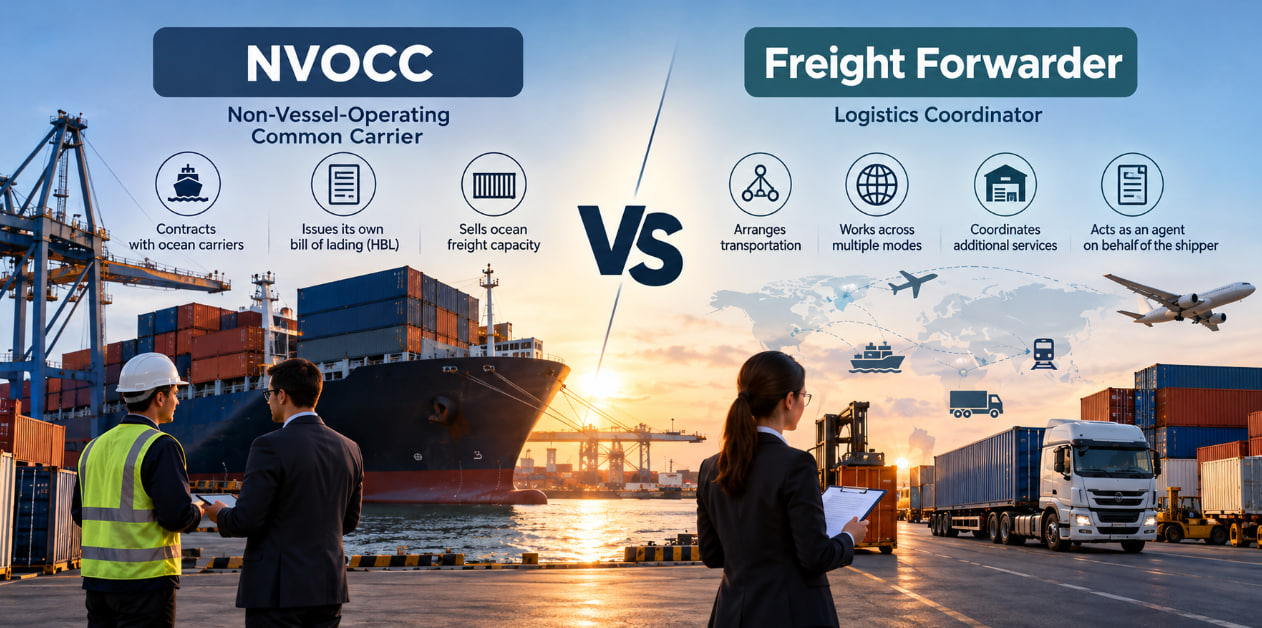
International shipping involves several companies that may appear to perform similar jobs. Two terms that cause particular confusion are NVOCC and freight forwarder.
Both can arrange ocean transportation. Both may work with shipping lines, trucking companies, warehouses, customs brokers, and other logistics providers. Some companies are authorized to operate as both.
But the legal and operational roles are different.
An NVOCC acts as a carrier in relation to the shipper even though it does not operate the vessel carrying the cargo. It contracts for ocean freight capacity from vessel-operating carriers and sells transportation services to customers under its own name.
A freight forwarder generally acts as an agent or logistics coordinator. It arranges transportation on behalf of the shipper and may coordinate several carriers and modes of transport within one shipment.
That distinction affects bills of lading, responsibility for transportation, pricing, carrier relationships, and the services a shipper receives.
What Is an NVOCC?
NVOCC stands for Non-Vessel-Operating Common Carrier.
The name describes the central feature of the business model: the company provides ocean transportation services without operating the vessel that physically carries the cargo.
An NVOCC typically contracts with vessel-operating ocean carriers for cargo space and then offers that capacity to its own customers. Because NVOCCs can combine freight volumes from multiple customers, they may negotiate carrier agreements based on expected volume, specific trade lanes, or longer-term commitments.
The relationship can be viewed in a simplified form:
Shipper → NVOCC → Ocean carrier
From the shipper’s perspective, the NVOCC is the transportation provider for the service it sells. From the vessel operator’s perspective, the NVOCC is a shipper purchasing ocean transportation.
This is different from simply introducing a shipper to a shipping line.
The NVOCC enters the transaction in a carrier role and can issue its own bill of lading for the transportation it provides.
An NVOCC may also offer additional services, including:
- inland trucking;
- drayage;
- customs-related coordination;
- warehousing;
- cargo consolidation;
- final delivery;
- shipment tracking.
Those additional services can make an NVOCC look very similar to a freight forwarder from the customer’s point of view.
What Is a Freight Forwarder?
A freight forwarder coordinates transportation on behalf of a shipper.
Rather than functioning primarily as the ocean carrier in the transaction, the forwarder organizes the different services required to move cargo from origin to destination.
Depending on the shipment, that can involve:
- ocean carriers;
- airlines;
- trucking companies;
- rail providers;
- warehouses;
- customs brokers;
- terminals;
- consolidation facilities;
- destination agents.
The freight forwarder may compare routes, make bookings, arrange pickup, coordinate documentation, monitor the shipment, and solve problems between the different providers involved.
That wider scope is an important distinction.
While the NVOCC role is tied primarily to ocean transportation, freight forwarding can include ocean, air, road, rail, or a combination of several modes.
For a shipper moving cargo from an inland factory in the United States to a customer’s warehouse overseas, the forwarder might coordinate the truck to the port, ocean transportation, destination customs procedures, another truck from the port, and final delivery.
The shipper therefore works with one logistics coordinator instead of arranging every part independently.
NVOCC vs. Freight Forwarder: Key Differences
The main differences become clearer when you compare the role each company plays in the shipment.
| Factor | NVOCC | Freight Forwarder |
|---|---|---|
| Main role | Acts as an ocean carrier without operating vessels | Coordinates transportation on behalf of the shipper |
| Primary transport | Ocean freight | Ocean, air, road, rail and multimodal |
| Ocean capacity | Contracts for capacity from vessel operators | Arranges bookings with carriers or NVOCCs |
| Legal position | Carrier in relation to the shipper | Usually acts as an agent or coordinator |
| Bill of lading | Can issue its own HBL when acting as NVOCC | Depends on the forwarder’s legal role and shipment structure |
| Pricing | Sells ocean freight capacity under its own rates | Charges for arranging transportation and related logistics services |
| Typical strength | Ocean capacity, carrier contracts, FCL/LCL transportation | End-to-end coordination across several services and modes |
| Best fit | Ocean-focused shipments and regular trade lanes | Shipments requiring wider logistics coordination |
The categories can overlap because one logistics company may be authorized to operate as both an NVOCC and a freight forwarder. What matters is the role it is performing for a particular shipment.
The Biggest Difference: Carrier vs. Agent
The most important distinction is not whether both companies can book a container.
It is the legal relationship they have with the shipper.
An NVOCC functions as a carrier for the ocean transportation service it sells. It can enter into transportation contracts with customers, issue its own transport document, and accept carrier responsibilities for the service covered by that document.
A freight forwarder generally acts on the shipper’s behalf by arranging transportation with the companies that will perform it.
The NVOCC sells ocean transportation as a carrier; the forwarder primarily organizes transportation as an intermediary.
That difference becomes especially important if cargo is damaged, lost, delayed, or delivered incorrectly.
With an NVOCC shipment, the customer normally has a contractual transportation relationship with the NVOCC under the bill of lading it issued. The NVOCC then has its own relationship with the underlying ocean carrier.
A freight forwarder’s responsibility depends on its actual role, the transport document used, applicable law, and the services covered by its agreement with the customer.
How Bills of Lading Work With an NVOCC
Bills of lading are one of the clearest ways to understand how the NVOCC model works.
Imagine an exporter books ocean transportation through an NVOCC.
The NVOCC contracts with an ocean shipping line for vessel space. The shipping line transports the container, but its customer for that booking is the NVOCC.
The document chain can therefore include:
House Bill of Lading (HBL): NVOCC → Shipper
Master Bill of Lading (MBL): Ocean carrier → NVOCC
For an LCL shipment, the NVOCC may issue separate house bills of lading to customers whose cargo is consolidated into the same container while receiving the carrier’s master bill for the underlying ocean movement.
This gives the NVOCC a direct contractual relationship with its customer while the vessel-operating carrier physically transports the cargo.
For a broader explanation of these documents, see RAM International Shipping’s guide to Bill of Lading (BOL).
Do Freight Forwarders Issue House Bills of Lading?
This is one area where simple comparisons can become misleading.
A freight forwarder acting purely as an agent arranges transportation on behalf of the shipper rather than acting as the ocean carrier. In that role, the carrier issues the transport bill of lading.
However, many logistics companies hold both freight forwarder and NVOCC authority. When the same company acts as an NVOCC for an ocean shipment, it can issue its own HBL in that carrier role.
Forwarders can also prepare and process shipping documents as part of their services, but that is different from issuing a carrier bill of lading in their own name.
The useful question is therefore:
Who is acting as the carrier for this shipment, and who is issuing the bill of lading?
That tells you more about the contractual structure than the company’s marketing description alone.
How an NVOCC Gets Ocean Freight Capacity
An NVOCC does not need to own a container vessel to sell ocean transportation.
Instead, it works with vessel-operating common carriers, often called VOCCs or simply ocean carriers.
An NVOCC can negotiate:
- freight rates;
- capacity allocations;
- service contracts;
- specific trade lanes;
- volume commitments;
- available sailings;
- free-time conditions;
- other commercial terms.
Because an NVOCC can combine the volume of many customers, it may have greater negotiating leverage than a small individual exporter shipping only a few containers each year.
This can be particularly useful during periods when vessel capacity is tight.
Access to carrier capacity can matter just as much as the quoted freight rate.
A low rate has little value if space cannot be secured on the required sailing.
This is why regular ocean shippers often look at carrier relationships and available capacity when choosing an NVOCC rather than comparing quotes solely by price.
How Freight Forwarders Arrange Transportation
A freight forwarder’s job is broader than obtaining vessel space.
Suppose a manufacturer needs to move machinery from an inland U.S. location to a customer’s facility overseas.
The shipment may require:
- Pickup from the factory.
- Truck transportation to a warehouse or port.
- Export documentation.
- Ocean freight booking.
- Port and terminal coordination.
- Customs procedures at destination.
- Inland transportation after arrival.
- Final delivery.
A freight forwarder can coordinate these activities across several independent providers.
It may book directly with an ocean carrier where its role and authority allow, or work through an NVOCC for the ocean portion of the shipment.
The value of the forwarder is often found in coordinating the complete shipment rather than providing only one transportation leg.
Ocean Freight vs. Multimodal Transportation
Another major difference is the range of transport modes.
The NVOCC role is primarily associated with ocean freight.
An NVOCC may arrange trucking, warehousing, or other supporting services around the ocean movement, but its defining carrier role relates to ocean transportation.
A freight forwarder can work across several modes.
For example:
Truck → Air Freight
or:
Truck → Ocean Freight → Rail → Truck
or:
Warehouse → Truck → Port → Ocean Freight → Destination Warehouse
This makes freight forwarding particularly useful when the shipper wants one company to coordinate a transportation chain involving several modes and service providers.
NVOCC and LCL Shipping
NVOCCs can play an important role in Less than Container Load transportation.
With LCL, one shipper does not use an entire container. Cargo from several customers can be consolidated into one container and transported together.
A typical process can include:
- Individual shipments arrive at a warehouse or Container Freight Station.
- Cargo from several shippers is consolidated.
- The NVOCC books container space with the ocean carrier.
- The container moves to the export port.
- The ocean carrier transports it to destination.
- Cargo is deconsolidated after arrival.
- Individual shipments continue to their respective consignees.
The NVOCC may issue an HBL for each customer’s shipment and receive an MBL from the ocean carrier for the underlying container movement.
This allows businesses with smaller shipments to access ocean transportation without paying for an entire container.
How Pricing Differs
NVOCCs and freight forwarders can also approach pricing differently.
An NVOCC may secure ocean freight rates through contracts or volume commitments with shipping lines and then sell transportation capacity to customers.
Its commercial model is based on the ocean transportation service it purchases and resells, together with any additional services included in the shipment.
A freight forwarder’s quote can include several separate parts of a shipment:
- carrier freight charges;
- trucking;
- warehousing;
- customs-related services;
- documentation;
- cargo handling;
- shipment coordination;
- other logistics services.
The forwarder may compare providers and build a transportation plan around the customer’s requirements.
Neither model automatically guarantees the lowest price.
An NVOCC may have attractive ocean rates because of carrier agreements and cargo volume. A freight forwarder may find a more efficient overall route or avoid additional costs elsewhere in the shipment.
The useful comparison is therefore total transportation cost and service scope, rather than the base ocean freight rate alone.
Can One Company Be Both an NVOCC and a Freight Forwarder?
Yes.
This is one of the main reasons the terminology becomes confusing.
A logistics company can hold the required authority to operate as both an NVOCC and an ocean freight forwarder. It can then perform different roles depending on the shipment.
For one customer, it might coordinate transportation as a forwarder.
For another, it may sell ocean freight under its own NVOCC bill of lading.
For a third, it could combine ocean transportation with inland delivery, warehousing, customs coordination, and other services.
The company name may stay the same while its contractual role changes.
When working with a provider that performs both functions, shippers should understand which role applies to their particular shipment.
Useful questions include:
- Who is the carrier under the bill of lading?
- Who is issuing the HBL?
- Who holds the contract with the ocean carrier?
- Who is arranging inland transportation?
- Who should handle a cargo claim?
- Which services are included in the quoted rate?
U.S. Regulation: What Does OTI Mean?
For U.S. ocean shipping, the term OTI is also important.
OTI stands for Ocean Transportation Intermediary.
Under U.S. Federal Maritime Commission rules, there are two types of OTIs:
- Ocean Freight Forwarders (OFFs);
- Non-Vessel-Operating Common Carriers (NVOCCs).
The requirements differ because the two businesses perform different roles.
An NVOCC is a common carrier that does not operate the vessels providing the ocean transportation and is considered a shipper in its relationship with the vessel-operating ocean carrier.
An Ocean Freight Forwarder arranges cargo movement from the United States to international destinations on behalf of shippers and performs documentation and related activities.
U.S.-based Ocean Freight Forwarders and NVOCCs are required to obtain FMC licenses. Foreign-based NVOCCs can operate under either FMC licensing or registration, provided the applicable regulatory requirements are met.
NVOCCs in U.S. trades also have requirements related to financial responsibility and tariff publication.
For shippers, the important point is simple:
Verify the provider’s authority and the role it will perform before booking the shipment.
This is especially important if it is unclear who will issue the transportation documents or which company is acting as the carrier.
When an NVOCC May Be the Better Fit
An NVOCC can be particularly useful when the shipment is primarily ocean-based and the shipper already understands much of the logistics process.
Typical situations include:
- regular FCL shipments;
- recurring trade lanes;
- large or predictable ocean freight volumes;
- businesses with their own customs and logistics capabilities;
- shippers mainly looking for ocean capacity;
- companies that want transportation under the NVOCC’s bill of lading.
For these shippers, access to carrier contracts and available vessel capacity may be more important than having a provider coordinate every logistics step.
A company shipping several containers each month on the same route may therefore have very different needs from a business sending its first international shipment.
When a Freight Forwarder May Be the Better Fit
A freight forwarder is often a better match when the shipment requires several transportation services to work together.
Examples include:
- cargo originating far from a port;
- shipments involving air and ocean freight;
- multiple pickup locations;
- irregular shipping lanes;
- customs coordination;
- warehousing;
- trucking before or after the ocean movement;
- businesses without an internal logistics department.
The forwarder can coordinate these services instead of requiring the shipper to work with every provider separately.
For companies that want both ocean capacity and wider logistics support, working with a provider that has both NVOCC and forwarding capabilities can combine these functions.
RAM International Shipping, for example, operates as a licensed NVOCC and coordinates FCL, LCL, inland transportation, drayage, warehousing, final delivery, and other services through its Ocean Freight Services.
NVOCC vs. Freight Forwarder for FCL Shipments
For a Full Container Load shipment, either type of provider may be involved.
An NVOCC may contract directly with the ocean carrier for space and sell the container movement to the shipper under its own bill of lading.
A freight forwarder may arrange an FCL booking as part of a broader logistics service that also includes pickup, port delivery, documentation, customs coordination, and final transportation.
For a business shipping regular containers on one trade lane, the NVOCC’s carrier agreements and capacity can be particularly important.
For an occasional shipper requiring several services, the forwarder’s coordination may be more valuable.
FCL alone does not determine which provider is better. The shipment’s route, frequency, service requirements, and internal logistics capabilities matter more.
NVOCC vs. Freight Forwarder for LCL Shipments
The same principle applies to LCL.
NVOCCs often consolidate LCL cargo and sell space within containers to multiple customers.
A freight forwarder can also arrange LCL transportation for its customer, potentially using an NVOCC to perform the ocean consolidation.
From the shipper’s point of view, both may appear to offer the same service.
Behind the scenes, however, the contractual structure can be different.
For an LCL shipper, useful questions include:
- Who is performing the consolidation?
- Where will cargo be received?
- Who issues the HBL?
- Which CFS will be used?
- Are origin and destination charges included?
- Who arranges delivery after deconsolidation?
These details often have a greater practical effect on the shipment than the provider’s job title alone.
How to Choose Between an NVOCC and Freight Forwarder
Start with what the shipment actually requires.
Consider the Transport Modes
If the shipment is primarily ocean freight, an NVOCC may provide what you need.
If it involves several transport modes, a freight forwarder may be better positioned to coordinate the complete route.
Consider Your Internal Logistics Experience
An experienced shipper with its own documentation, customs, trucking, and destination arrangements may mainly need competitive vessel space.
A company without that internal capability may benefit more from a provider that coordinates the wider shipment.
Ask Who Issues the Bill of Lading
This helps clarify the provider’s legal role.
Do not assume the answer based only on whether the company markets itself as a freight forwarder.
Many logistics companies perform more than one role.
Compare Total Cost
A cheaper ocean freight rate does not necessarily mean a cheaper shipment.
Check:
- origin charges;
- drayage;
- documentation fees;
- terminal charges;
- warehousing;
- customs-related fees;
- destination charges;
- final delivery.
The useful number is the cost of getting the shipment where it actually needs to go.
Check Carrier Relationships and Capacity
For ocean freight, ask which carriers and trade lanes the provider works with.
Regular carrier relationships can affect:
- rates;
- vessel options;
- available capacity;
- schedule flexibility;
- options when disruptions occur.
Understand Responsibility Before Booking
If something goes wrong, you should already know who to contact.
Ask who will handle:
- cargo damage;
- loss;
- vessel delays;
- rolled bookings;
- documentation problems;
- destination issues.
The time to understand responsibility is before the container is on the water, not after a problem occurs.
Frequently Asked Questions About NVOCC vs. Freight Forwarder
What does NVOCC stand for?
NVOCC stands for Non-Vessel-Operating Common Carrier.
It provides ocean transportation services without operating the vessel that carries the cargo. It typically contracts for capacity with vessel-operating carriers and sells transportation to shippers.
What is the main difference between an NVOCC and a freight forwarder?
An NVOCC acts as an ocean carrier in relation to its customer, while a freight forwarder generally acts as an agent or logistics coordinator arranging transportation on behalf of the shipper.
Does an NVOCC own ships?
No. The defining feature of an NVOCC is that it provides common-carrier ocean transportation without operating the vessels used to perform that transportation.
The vessel itself is operated by a vessel-operating ocean carrier.
Can an NVOCC own containers?
Yes, an NVOCC may own or lease containers, but owning containers is not what defines the business.
The defining point is that it acts as a carrier without operating the vessel used for the ocean transportation.
Can an NVOCC also be a freight forwarder?
Yes.
A company may have authority to perform both functions. What matters is which role the provider is performing for the specific shipment.
Does an NVOCC issue a bill of lading?
Yes. An NVOCC can issue its own house bill of lading to the shipper while receiving a master bill of lading from the underlying vessel-operating carrier.
Can a freight forwarder arrange ocean freight?
Yes.
Freight forwarders regularly arrange ocean shipments. They may arrange transportation with ocean carriers or work with NVOCCs as part of the shipping process.
Which is cheaper: an NVOCC or a freight forwarder?
There is no fixed answer.
NVOCCs may obtain competitive ocean rates through their carrier agreements and combined cargo volume. Freight forwarders may reduce overall costs by coordinating the complete route and comparing several logistics options.
Compare the total cost and complete service scope, not only the base ocean rate.
Which should a first-time international shipper use?
A first-time shipper will often need more than vessel space. Documentation, inland transportation, customs coordination, and destination delivery may also need to be arranged.
A full-service freight forwarder, or a provider that combines freight forwarding with NVOCC capabilities, may therefore be more practical.
NVOCC vs. Freight Forwarder: The Main Point
NVOCCs and freight forwarders often work with the same cargo, carriers, ports, warehouses, and customers. That overlap explains why the terms are frequently confused.
The core difference is the role each company plays.
An NVOCC provides ocean transportation as a carrier without operating the vessel. A freight forwarder primarily coordinates transportation on behalf of the shipper.
An NVOCC can contract for ocean capacity, sell that transportation to customers, and issue its own bill of lading. A freight forwarder can coordinate a wider transportation chain involving ocean, air, trucking, rail, warehousing, documentation, and other logistics services.
Neither option is automatically better.
A shipper with regular ocean volume may care most about carrier contracts, available space, and rates. Another business may need one provider to coordinate pickup, export documentation, ocean freight, customs, warehousing, and final delivery.
In many cases, the same logistics company can perform both roles.
For the shipper, the important questions are practical: Who is the carrier? Who issues the bill of lading? Who holds the carrier contract? What services are included? And who is responsible if something goes wrong?
Once those points are clear, the difference between an NVOCC and a freight forwarder becomes much easier to understand.