When freight is booked, someone has to be responsible for the carrier’s transportation charges. Two terms commonly used to identify that responsibility are freight prepaid and freight collect.
The basic difference is simple:
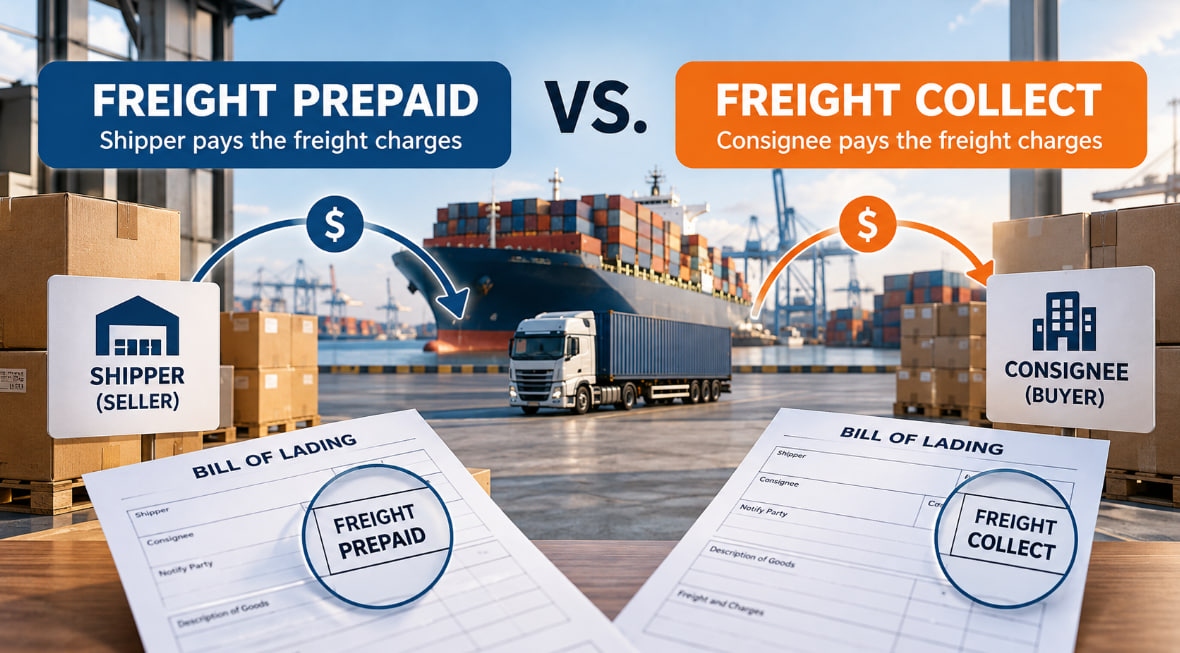
Freight prepaid means the shipper is billed for the freight charges.
Freight collect means the consignee or receiving party is billed for the freight charges.
Confusion often starts when these payment terms are mixed with questions about ownership, risk, carrier selection, or Incoterms. Freight prepaid and freight collect primarily answer who the carrier bills for transportation. They do not, by themselves, determine who owns the goods while they are in transit or when risk passes from one party to another.
Understanding that distinction is useful for domestic freight and becomes even more important when transportation is one part of a larger international shipment.
What Does Freight Prepaid Mean?
Freight prepaid means the shipper, usually the seller or another origin-side party, is responsible for the carrier’s freight charges.
The carrier invoices the shipper or another payer designated by the shipper. On a bill of lading, the freight terms are normally marked as Prepaid.
A common freight prepaid arrangement works like this:
- The seller prepares the shipment.
- The seller chooses or arranges the carrier.
- The carrier picks up and transports the cargo.
- The carrier bills the seller for the freight.
- The seller may include that transportation cost in the price charged to the buyer.
This last point is important.
Freight prepaid does not necessarily mean the seller absorbs the transportation cost.
The seller may recover the freight cost by including it in the product price or listing it separately on the commercial invoice. From the carrier’s perspective, however, the shipment is still prepaid because the shipper is the party being billed.
The term “prepaid” can also be misleading. It does not always mean that the carrier literally receives payment before the truck, vessel, or other transportation departs. Established customers may have credit terms and receive an invoice after the shipment moves.
The key question is who is responsible for the freight invoice, not necessarily when the payment reaches the carrier.
What Does Freight Collect Mean?
Freight collect means the consignee or receiving party is responsible for the carrier’s freight charges.
Instead of invoicing the shipper, the carrier invoices the receiver according to the agreed billing arrangement.
A typical freight collect shipment works like this:
- The seller prepares the cargo for pickup.
- The buyer provides routing or carrier instructions.
- The carrier collects the shipment from the seller.
- The cargo moves to the buyer.
- The carrier bills the buyer or consignee.
In this arrangement, the buyer often uses its own carrier relationships and negotiated rates.
For companies that receive freight from many suppliers, this can be useful because they can consolidate transportation spending rather than allowing every supplier to arrange shipping independently.
Freight collect often gives the receiving party more direct control over the transportation purchase.
That can include carrier selection, negotiated pricing, routing, service levels, and shipment visibility.
Freight Prepaid vs. Freight Collect: Key Differences
The most obvious difference is who receives the freight bill, but that often affects who controls other transportation decisions.
| Factor | Freight Prepaid | Freight Collect |
|---|---|---|
| Who carrier bills | Shipper / seller | Consignee / buyer |
| Typical carrier selection | Shipper | Buyer |
| Whose freight rates often apply | Shipper’s | Buyer’s |
| BOL designation | Prepaid | Collect |
| Transportation coordination | Usually controlled by shipper | Usually controlled by buyer |
| Freight cost | May be included in product price or added separately | Usually billed directly to receiver |
| Carrier credit | Usually shipper’s account | Usually consignee’s account |
| Seller cash flow | Seller initially carries freight expense | Seller avoids directly funding freight |
| Buyer visibility into freight cost | May be lower if included in price | Usually higher |
These are common arrangements rather than fixed rules.
The purchase order, transportation agreement, sales contract, and bill of lading should all reflect the same agreed billing structure.
Who Pays Under Freight Prepaid?
Under freight prepaid terms, the shipper is responsible for the carrier’s freight invoice.
For example, imagine a manufacturer sells machinery to another company.
The manufacturer may:
- select the transportation provider;
- arrange pickup;
- negotiate the freight rate;
- coordinate the shipment;
- receive the carrier’s invoice.
The buyer may see a single delivered price covering both the machinery and transportation.
Alternatively, the seller may show freight as a separate charge on its commercial invoice.
Either way, the carrier bills the seller or the seller’s designated payer rather than the consignee.
This setup can be convenient for buyers that do not want to manage carrier relationships themselves.
It can also make sense when the seller has strong freight rates because of its shipping volume.
Who Pays Under Freight Collect?
Under freight collect terms, the receiving party normally pays the carrier.
For example, a retailer may buy products from dozens or hundreds of suppliers but require those suppliers to ship using the retailer’s contracted carriers.
The supplier prepares the order and follows the buyer’s routing instructions.
The buyer may:
- select the carrier;
- provide its carrier account information;
- control the routing;
- choose the service level;
- pay the freight bill.
This allows a large buyer to use the same transportation contracts across many suppliers.
It can also give the buyer clearer visibility into what freight actually costs.
One practical issue is carrier credit.
The consignee generally needs an acceptable billing arrangement with the carrier for collect freight.
If the receiver does not have an approved account or another accepted payment arrangement, the carrier may require payment before delivery or may decline the collect billing arrangement.
Freight Prepaid Does Not Mean Free Shipping
A common misunderstanding is that freight prepaid means the buyer does not pay for transportation.
The buyer may not receive the freight invoice directly, but the transportation cost still exists.
A seller can:
- include freight in the product price;
- charge a delivered price;
- add freight as a separate invoice line;
- recover transportation costs through its overall pricing.
For example:
Product price without freight: $10,000
Freight cost: $900
The seller could quote a total delivered price of $10,900.
Or the invoice could show:
Product: $10,000
Freight: $900
In both cases, the carrier may still treat the shipment as freight prepaid because the seller is responsible for the carrier invoice.
Who receives the carrier’s invoice and who ultimately bears the economic cost are not always the same question.
What Is Freight Prepaid and Add?
Freight prepaid and add is a common variation of freight prepaid.
The seller is billed by the carrier and then adds the freight charge to the buyer’s invoice as a separate line.
For example:
Goods: $15,000
Freight: $1,200
Total invoice: $16,200
The carrier still bills the seller.
What changes is how the seller passes the transportation cost to the buyer.
With standard prepaid freight, the shipping cost may be included in the product price. With prepaid and add, the freight charge is shown separately.
Prepaid and add makes the transportation cost more visible to the buyer, but the seller remains the party billed by the carrier.
The amount added to the invoice may also depend on the commercial agreement between the parties, so buyers should confirm whether freight is being passed through at cost or whether additional handling charges are included.
Freight Prepaid vs. Freight Collect on the Bill of Lading
The bill of lading is particularly important because it identifies the freight billing terms.
For prepaid freight, the BOL will generally indicate:
Freight Prepaid
For collect freight, it will indicate:
Freight Collect
An incorrect designation can create problems because the carrier may invoice the wrong company.
This can lead to:
- rebilling;
- delayed payment;
- billing disputes;
- additional administrative work;
- disagreements between buyer and seller.
The payment designation on the BOL should match the purchase order and agreed routing instructions before the shipment moves.
For a broader explanation of the document itself, see RAM International Shipping’s guide to the Bill of Lading (BOL).
Freight Payment and Ownership Are Different Questions
One of the most important points about freight prepaid vs. freight collect is what these terms do not determine.
They do not automatically tell you:
- who owns the goods while they are moving;
- when risk transfers between buyer and seller;
- which party is responsible for cargo damage;
- who has export or import obligations;
- where delivery is considered complete.
The freight billing term primarily identifies who the carrier bills.
Ownership, risk, delivery obligations, and other commercial responsibilities are determined by separate contractual terms.
This is why statements such as:
“Seller paid the freight, so the seller owns the cargo”
or:
“Buyer paid the freight, so the buyer has all transportation risk”
can be incorrect.
Payment responsibility and risk allocation are separate issues.
Freight Prepaid, Freight Collect, and FOB Terms
Freight billing terms are sometimes shown alongside FOB terms, especially in U.S. domestic transportation and purchase orders.
Examples can include:
- FOB Origin, Freight Collect;
- FOB Origin, Freight Prepaid;
- FOB Destination, Freight Prepaid;
- FOB Destination, Freight Collect.
In that context, the terms answer different questions.
Prepaid or collect identifies who the carrier bills.
FOB Origin or FOB Destination addresses where responsibility for the goods shifts under the applicable domestic commercial arrangement.
This means the seller can pay transportation even when responsibility for the cargo has already shifted to the buyer. The opposite arrangement is also possible.
For international trade, the distinction requires extra care because Incoterms such as FOB, FCA, CIF, CPT, DAP, and DDP define broader responsibilities for delivery, costs, and risk between seller and buyer.
For example, FOB under Incoterms has a specific meaning for sea and inland waterway transport and should not be treated as identical to domestic U.S. “FOB Origin” or “FOB Destination” terminology.
A freight billing term does not replace the Incoterm in an international sales contract.
Does Freight Prepaid Give the Seller More Control?
Usually, it does.
If the seller is arranging transportation and is responsible for the carrier invoice, it will often control:
- carrier selection;
- service level;
- pickup scheduling;
- routing;
- transportation provider;
- negotiated freight rate.
This can be useful when the seller has an experienced logistics team or strong carrier relationships.
The seller can also manage delivery performance more directly instead of depending on the buyer’s carrier network.
However, control comes with additional work.
The seller may need to manage carrier invoices, accessorial charges, scheduling, tracking, and billing disputes.
Does Freight Collect Give the Buyer More Control?
Often, yes.
Under a collect arrangement, the buyer may select the carrier and use its own transportation account.
This is common where buyers have substantial shipping volume and can negotiate better freight rates than individual suppliers.
The buyer may control:
- carrier selection;
- routing;
- service level;
- pickup instructions;
- freight spend;
- shipment visibility.
For the seller, this reduces the work involved in managing outbound transportation.
The trade-off is less control over how and when the shipment moves.
For example, the buyer may choose a lower-cost service with a longer transit time, while the seller might otherwise have selected a faster option.
Cash Flow Differences
The choice can also affect cash flow.
With freight prepaid, the seller receives the transportation bill.
That means the seller may need to fund freight before receiving full payment from the customer.
For businesses shipping expensive international freight, this can represent a meaningful working-capital requirement.
With freight collect, the direct freight expense moves to the buyer or consignee.
The seller therefore avoids initially funding the carrier charge.
For the buyer, the situation is reversed. It must manage transportation payments in addition to paying for the goods.
The better structure depends partly on which party is better positioned to manage freight spending and carrier relationships.
How Do These Terms Work in International Shipping?
The same basic payment concept can appear in international freight: certain transportation charges can be assigned to the origin side or destination side.
However, international shipments often contain several separate charges rather than one simple freight bill.
Depending on the route, costs may include:
- origin trucking;
- export handling;
- ocean or air freight;
- terminal charges;
- documentation;
- destination handling;
- customs-related charges;
- inland delivery.
That makes it important to define exactly which charges are prepaid and which remain payable at destination.
A shipment can have the main ocean freight prepaid while certain destination charges remain collect.
For international transportation, shippers should therefore review the full quotation rather than relying only on a “prepaid” or “collect” label.
RAM International Shipping provides FCL, LCL, RoRo, project cargo, and related international transportation through its Ocean Freight Services.
Which Is Better: Freight Prepaid or Freight Collect?
Neither option is automatically better.
The better choice depends on who has stronger transportation capabilities, better rates, and more reason to control the shipment.
Freight Prepaid May Make Sense When:
- the seller has better carrier rates;
- the buyer wants a simpler delivered price;
- the seller wants to control transportation;
- the buyer does not have established carrier accounts;
- the seller regularly manages outbound freight.
Freight Collect May Make Sense When:
- the buyer has stronger negotiated carrier rates;
- the buyer wants direct visibility into freight costs;
- the buyer manages transportation across many suppliers;
- the buyer wants to control routing and service levels;
- the seller wants to reduce transportation administration.
For large organizations, transportation control can be just as important as the freight rate itself.
A buyer with an established carrier network may prefer collect freight because it can combine volume across suppliers and negotiate transportation agreements centrally.
A smaller buyer may prefer prepaid freight because the seller already has the systems and relationships needed to manage shipping.
How to Compare the Real Cost
Do not compare only the product price.
Suppose Supplier A offers:
Product with freight included: $20,000
Supplier B offers:
Product: $19,300
Freight collect estimate: $1,000
Total: $20,300
Supplier B appears cheaper if only the merchandise price is compared.
Once transportation is included, Supplier A is cheaper.
The opposite can happen when the buyer has substantially better contracted freight rates than the seller.
The useful comparison is the complete transportation and purchase cost, not simply who receives the freight invoice.
Businesses planning an international shipment can use RAM International Shipping’s Freight Rate Calculator to review freight options for a specific shipment.
Common Freight Prepaid and Freight Collect Mistakes
Assuming Prepaid Means the Freight Is Free
The seller may simply include transportation in the product price.
Always compare the complete commercial cost.
Treating Payment Terms as Risk Terms
Freight prepaid and freight collect identify billing responsibility.
They do not, by themselves, determine cargo ownership or risk in transit.
Marking the Wrong Term on the BOL
If the purchase order says collect but the BOL says prepaid, the carrier may invoice the wrong party.
The documents should be consistent.
Ignoring Carrier Credit Requirements
A company receiving collect freight may need an approved carrier account or another accepted payment arrangement.
This should be confirmed before pickup.
Comparing Only the Freight Rate
Carrier selection also affects:
- transit time;
- reliability;
- available capacity;
- tracking;
- claims handling;
- pickup performance.
A lower rate is not always the better transportation option.
Frequently Asked Questions About Freight Prepaid vs. Freight Collect
What is the main difference between freight prepaid and freight collect?
Freight prepaid means the shipper is billed for the freight charges.
Freight collect means the consignee or receiving party is billed for those charges.
Does freight prepaid mean shipping is free for the buyer?
No.
The seller may include transportation in the product price or charge it separately.
“Prepaid” identifies who the carrier bills, not whether the buyer ultimately bears any of the transportation cost.
Does prepaid mean the carrier is paid before shipping?
Not necessarily.
A shipper with carrier credit may receive an invoice after the shipment has moved. The term identifies billing responsibility rather than requiring payment before departure.
Who chooses the carrier with freight collect?
The buyer or consignee often chooses the carrier and provides routing instructions, particularly when it uses its own contracted rates.
The exact arrangement depends on the agreement between the parties.
Who chooses the carrier with freight prepaid?
The seller or shipper usually arranges transportation because it is responsible for the freight bill.
However, the parties can agree on a different arrangement.
Where are freight prepaid or collect terms shown?
They are commonly shown on the bill of lading and may also appear in purchase orders, routing instructions, transportation agreements, or other shipping documents.
Is freight prepaid the same as FOB Destination?
No.
Freight prepaid is a billing term. FOB Destination in the U.S. domestic context addresses a different part of the buyer-seller relationship.
The terms can appear together, but one does not automatically determine the other.
Is freight collect the same as FOB Origin?
No.
They are commonly paired when the buyer controls transportation, but they answer different questions.
Freight collect identifies who the carrier bills. FOB Origin addresses the transfer point for responsibility under the applicable domestic terms.
Can freight be prepaid and then charged to the buyer?
Yes.
This is commonly called freight prepaid and add.
The seller is billed by the carrier and then adds the transportation charge to the buyer’s invoice.
Freight Prepaid vs. Freight Collect: The Main Point
The difference between freight prepaid and freight collect comes down to the carrier’s freight bill.
Freight prepaid: the shipper is billed by the carrier.
Freight collect: the consignee is billed by the carrier.
That billing decision often influences who chooses the carrier, negotiates the rate, controls routing, and manages transportation.
But it should not be confused with ownership or risk.
A seller can pay the freight while risk has already passed to the buyer under the applicable commercial terms. A buyer can pay the carrier while other responsibilities remain with the seller.
For that reason, buyers and sellers should review the freight billing term together with the purchase order, bill of lading, sales contract, and any applicable Incoterms or other delivery terms.
The practical question is not simply who pays the freight. It is who controls the transportation, whose carrier rates apply, what charges are included, and how those choices affect the total cost of the shipment.