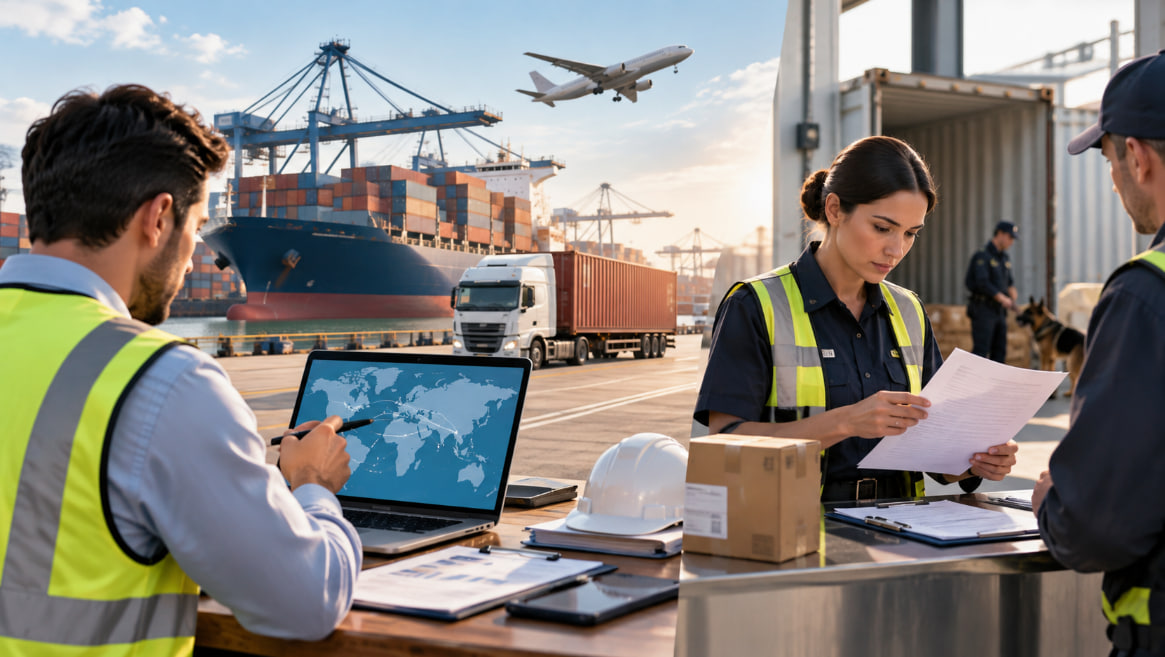
International shipments often involve several companies between the seller and the final customer. Two of the most important are the freight forwarder and the customs broker.
Their work can overlap, and the same logistics company may offer both services. But their main responsibilities are different.
A freight forwarder focuses on moving cargo from origin to destination. A customs broker focuses on getting the shipment through customs in accordance with import regulations.
For a shipment entering the United States, the difference can be summarized simply:
Freight forwarder → transportation and logistics
Customs broker → customs entry and import compliance
For many international shipments, you may need both.
What Is a Freight Forwarder?
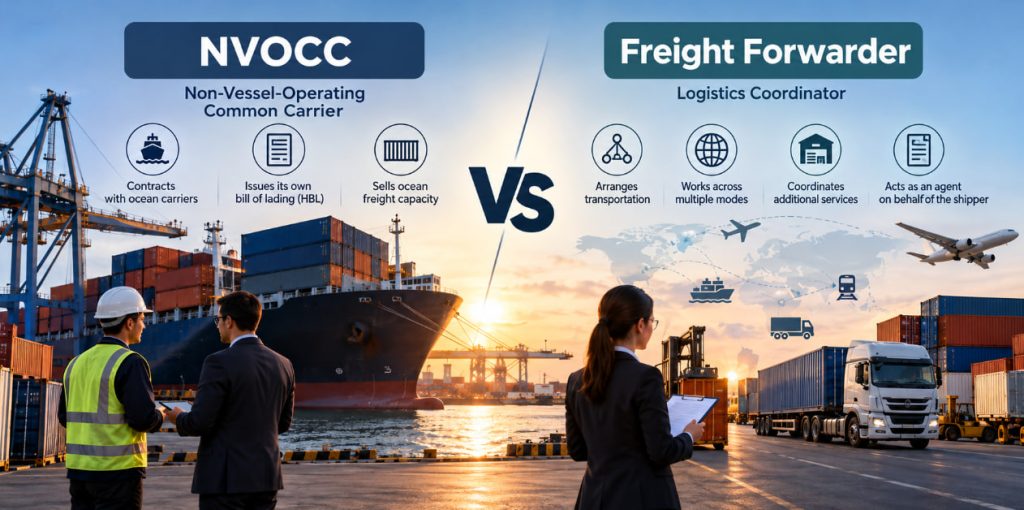
A freight forwarder arranges transportation for cargo on behalf of a shipper, importer, exporter, or consignee.
The forwarder does not necessarily operate the truck, aircraft, train, or vessel carrying the goods. Instead, it coordinates the companies and services required to move the shipment.
Depending on the route, that can include:
- truck transportation;
- ocean freight;
- air freight;
- rail transportation;
- cargo consolidation;
- warehousing;
- pickup and final delivery;
- cargo insurance arrangements;
- shipping documentation;
- shipment tracking.
For example, an importer may need to move machinery from a factory in Germany to a warehouse in Illinois.
The freight forwarder could arrange:
- Pickup from the German factory.
- Truck transportation to the export port.
- Ocean freight to the United States.
- Coordination with the destination terminal.
- Inland transportation from the U.S. port.
- Final delivery to the importer.
The forwarder connects these individual transportation stages into one shipping plan.
The forwarder may also advise the customer on routing, carrier options, expected transit times, packaging considerations, cargo insurance, and documentation required for transportation.
RAM International Shipping coordinates international container transportation, FCL and LCL shipments, inland transportation, drayage, and related services through its Ocean Freight Services.
What Is a Customs Broker?
A customs broker deals with customs clearance and the government requirements connected with importing goods.
In the United States, customs brokers are licensed by U.S. Customs and Border Protection (CBP) to conduct customs business on behalf of other parties.
That customs business can include transactions related to:
- entry of merchandise;
- admissibility;
- tariff classification;
- customs valuation;
- duties and taxes;
- customs documentation;
- electronic filings with CBP.
A broker needs detailed knowledge of customs regulations, tariff schedules, classification rules, valuation requirements, and restrictions that may apply to specific commodities.
A customs broker may help an importer:
- classify products using the appropriate HTS codes;
- prepare or review customs entries;
- calculate duties and applicable fees;
- transmit required information to CBP;
- coordinate customs bonds;
- work with CBP when questions or inspections occur;
- identify additional requirements from other government agencies.
The broker’s main job is not to move the cargo. It is to handle customs-related procedures so the shipment can legally enter the country.
Businesses importing into the United States can work with RAM International Shipping for documentation and clearance support through its Customs Clearance Services.
Freight Forwarder vs. Customs Broker: Key Differences
The main difference is the part of the shipment each provider manages.
| Factor | Freight Forwarder | Customs Broker |
|---|---|---|
| Main responsibility | Transportation and logistics | Customs clearance and import compliance |
| Main focus | Moving cargo from origin to destination | Clearing cargo through customs |
| Works with | Shippers, carriers, warehouses, terminals, brokers | Importers, CBP and other government agencies |
| Transportation booking | Yes | Usually not the main role |
| Carrier selection | Yes | Usually no |
| Cargo consolidation | Often | No |
| Warehousing coordination | Often | Not the main role |
| Customs classification | May assist with information | Core service |
| Duty calculation | May provide estimates | Core service |
| Customs entry filing | Only through the appropriate licensed customs brokerage role | Yes |
| U.S. licensing | Depends on the forwarding activity | CBP customs broker license required to conduct customs business for others |
The two services are therefore complementary rather than interchangeable.
A forwarder can arrange transportation of a container to a U.S. port, but the cargo still needs to satisfy customs requirements before it can be released.
A customs broker can clear the cargo through customs, but that does not mean the broker arranged the vessel, origin pickup, or final delivery.
A Simple Example
Suppose a U.S. company purchases industrial equipment from an Italian manufacturer.
The equipment needs to travel from Milan to New York and then by truck to the buyer’s facility.
The freight forwarder may:
- arrange pickup from the manufacturer’s facility;
- book ocean transportation;
- coordinate delivery to the export terminal;
- monitor the shipment;
- arrange destination trucking.
The customs broker may:
- review the commercial documentation;
- determine the correct tariff classification;
- prepare the customs entry;
- calculate duties and fees;
- submit the required information to CBP;
- respond to customs questions if necessary.
Once the shipment is released, transportation to the final destination can continue.
The forwarder manages how the cargo gets there. The customs broker manages how it gets through customs.
Does a Freight Forwarder Handle Customs Clearance?
Sometimes.
Many freight forwarding companies also offer customs brokerage services. They may have a licensed customs brokerage operation within the company or work with a separate licensed broker.
That means a customer can sometimes use one logistics provider for:
- freight booking;
- transportation;
- customs clearance;
- inland delivery.
But offering freight forwarding services does not automatically give a company authority to conduct customs business.
In the United States, a company conducting customs business on behalf of another party generally needs the appropriate customs broker license.
This distinction matters when comparing logistics providers.
One forwarder may coordinate customs clearance through an outside brokerage partner. Another may have its own licensed brokerage operation.
For the importer, both arrangements can work. The important point is knowing who is actually responsible for filing the customs entry and communicating with CBP.
Can a Customs Broker Arrange Freight?
Some customs brokerage companies also offer freight forwarding or transportation services.
Again, that does not make the two roles the same.
A company can operate several divisions or hold the required licenses and authority to provide both services. In that case, the same business may coordinate transportation and handle customs clearance.
The services should still be viewed separately:
Freight forwarding service: transportation and logistics coordination.
Customs brokerage service: customs entry and compliance.
This distinction can become important when reviewing quotes, contracts, responsibilities, and problems that occur during a shipment.
Who Hires the Freight Forwarder?
The answer depends on the commercial agreement between the buyer and seller.
In some export transactions, the seller hires the freight forwarder and arranges transportation.
In others, the buyer controls the freight and appoints its own forwarder.
Incoterms can influence which party is responsible for arranging different parts of transportation, but the exact responsibilities should always be checked against the sales contract.
A forwarder may therefore work for:
- the exporter;
- the importer;
- the seller;
- the buyer;
- another party responsible for arranging transportation.
The forwarder’s role remains focused on transportation and logistics regardless of which commercial party hired it.
Who Hires the Customs Broker?
For imports into the United States, the importer commonly appoints a customs broker.
The broker conducts customs business on behalf of the client and generally requires authorization from that client.
The broker can prepare filings and communicate with CBP, but using a customs broker does not remove the importer’s compliance responsibilities.
The importer of record remains responsible for using reasonable care and for the accuracy of information submitted to CBP, including classification, valuation, and other information required for the entry.
This means businesses should provide accurate information about:
- the merchandise;
- country of origin;
- value;
- quantity;
- manufacturer;
- intended use;
- supporting documents.
A broker can work with the information provided, but incomplete or incorrect product details can result in incorrect filings or clearance problems.
What Does a Customs Broker Check?
Customs clearance involves much more than submitting one document.
A broker may need to review several parts of the import transaction.
HTS Classification
Imported merchandise must be classified under the Harmonized Tariff Schedule of the United States.
The classification affects the applicable duty rate and can also affect other import requirements.
Choosing an incorrect code may result in incorrect duties, customs questions, or penalties.
Customs Value
The customs value must be determined according to the applicable valuation rules.
The broker may review the commercial invoice and other transaction information when preparing the entry.
Duties, Taxes, and Fees
Once classification and customs value are established, applicable duties and other charges can be calculated.
The broker may facilitate payment as part of the clearance process.
Admissibility
Some goods require information, permits, or approvals from agencies other than CBP.
Depending on the product, this may involve agencies such as the FDA, USDA, EPA, DOT, or other authorities.
Import Documentation
Depending on the shipment, documents and filings may include:
- commercial invoice;
- packing list;
- bill of lading or air waybill;
- customs entry information;
- certificates;
- permits;
- other commodity-specific documentation.
The exact requirements depend on the product, origin, transportation mode, and type of entry.
What Does a Freight Forwarder Check?
The forwarder looks at the shipment from a logistics perspective.
Typical questions include:
- Where is the cargo located?
- Where does it need to go?
- How quickly does it need to arrive?
- Is ocean or air freight more appropriate?
- Is the shipment FCL or LCL?
- What are the weight and dimensions?
- Does the cargo require special handling?
- Which carrier and route should be used?
- Is warehousing required?
- Who will handle pickup and delivery?
The forwarder then coordinates the required transportation services.
A shipment may involve several providers, but the shipper does not necessarily need to negotiate separately with every trucker, airline, ocean carrier, terminal, or warehouse.
The freight forwarder can coordinate those relationships as part of the shipment.
What Happens When the Forwarder and Broker Work Together?
For many international shipments, cooperation between the two is routine.
Consider an ocean import entering the United States.
The process may look like this:
- The freight forwarder arranges pickup at origin.
- Cargo travels to the export port.
- The forwarder arranges the ocean booking.
- Shipping documents are prepared and shared.
- The customs broker receives the required import information.
- The broker prepares the customs entry and related filings.
- Cargo arrives in the United States.
- CBP reviews the entry and, if requirements are met, releases the cargo.
- The forwarder coordinates pickup from the terminal.
- The cargo is delivered to the final destination.
The process does not always happen in exactly this order. Customs work can begin well before the vessel reaches the United States.
But the basic division remains:
The forwarder manages cargo movement. The broker manages customs clearance.
Do You Legally Need a Customs Broker?
In the United States, an importer is not legally required to hire a customs broker to conduct customs business solely on its own account.
An eligible importer may make entry for its own merchandise without holding a customs broker license.
That does not mean self-filing is simple.
The importer needs to understand classification, valuation, customs procedures, applicable duties, documentation, and any requirements imposed by other government agencies.
For businesses without internal customs expertise, using a licensed broker can make the process more manageable and reduce the likelihood of avoidable filing errors.
Hiring a customs broker is optional for eligible importers filing their own entries, but responsibility for compliance does not disappear when a broker is used.
Are Freight Forwarders Licensed in the United States?
The answer depends on the transportation mode and the activity being performed.
For ocean transportation in U.S. trades, an Ocean Freight Forwarder is considered an Ocean Transportation Intermediary, or OTI, and is regulated by the Federal Maritime Commission.
U.S.-based Ocean Freight Forwarders must obtain the appropriate FMC license and provide proof of financial responsibility before offering these services.
This licensing is separate from a CBP customs broker license.
That is another reason it is incorrect to treat “freight forwarder” and “customs broker” as two names for the same business.
They perform different regulated activities and are overseen by different federal agencies for those activities.
When Do You Need a Freight Forwarder?
A freight forwarder can be useful when you need help organizing transportation instead of dealing directly with every carrier and service provider.
Typical situations include:
- international ocean shipments;
- air freight;
- shipments involving several transport modes;
- cargo moving from an inland origin;
- door-to-door transportation;
- FCL and LCL shipments;
- cargo requiring consolidation;
- shipments involving origin or destination warehousing;
- businesses shipping to unfamiliar countries.
Experienced companies also use forwarders even when they have internal logistics teams because forwarders can provide access to carrier networks, routing options, and local partners.
When Do You Need a Customs Broker?
A customs broker becomes relevant when cargo must go through customs and the importer does not plan to handle the process internally.
A broker can be particularly useful when:
- the importer is unfamiliar with U.S. customs procedures;
- products are difficult to classify;
- goods are subject to significant duties;
- multiple government agencies regulate the merchandise;
- documentation requirements are complicated;
- shipments arrive regularly;
- compliance errors could cause expensive delays.
A broker may also identify missing information before the cargo reaches the port, when there is still time to correct it.
Do You Need Both?
For many international imports, yes.
A company importing ocean freight into the United States may use:
Freight forwarder: to move the shipment from the foreign supplier to the U.S. destination.
Customs broker: to clear the shipment through U.S. customs.
If one provider offers both services, the importer may be able to manage the shipment through a single point of contact.
That can simplify communication, but it does not change the underlying responsibilities.
Transportation and customs clearance remain separate functions even when the same company provides both.
Common Mistakes When Choosing a Forwarder or Broker
Assuming a Freight Forwarder Automatically Handles Customs
Some do. Some do not.
Ask whether customs brokerage is handled through the provider’s own licensed brokerage operation or through another company.
Waiting Until Cargo Arrives to Arrange Clearance
Customs documentation should be reviewed before arrival.
Missing classifications, invoices, permits, or other information can create avoidable delays once the cargo reaches the port.
Choosing Only by Price
The lowest freight rate or brokerage fee does not tell you how well the provider handles problems.
For international shipments, experience with the relevant trade lane, commodity, documentation, and regulations can matter more than a small difference in service fees.
Providing Incomplete Product Information
A broker cannot properly prepare an entry without accurate information.
The importer should be ready to provide clear product descriptions, composition where relevant, intended use, origin, value, quantity, and supporting documents.
Assuming the Broker Takes Over the Importer’s Responsibility
The broker performs customs work on behalf of the importer.
The importer of record remains responsible for the correctness of the entry information and applicable duties, taxes, and fees.
Frequently Asked Questions
What is the main difference between a freight forwarder and a customs broker?
A freight forwarder arranges transportation and logistics. A customs broker handles customs clearance and import compliance.
Can a freight forwarder also be a customs broker?
Yes. A logistics company can offer both services if it has the appropriate licensing and authority. Some forwarding companies have their own licensed customs brokerage operations, while others work with brokerage partners.
Can a customs broker also be a freight forwarder?
Yes, if the company also has the appropriate capabilities and any required authority for the forwarding services it provides.
Does a freight forwarder clear goods through customs?
Not automatically.
The company must provide customs brokerage through the appropriate licensed operation or work with a licensed customs broker.
Freight forwarding itself does not authorize a company to conduct customs business on behalf of other parties.
Is a customs broker required for U.S. imports?
No.
Eligible importers can make entry for their own goods. However, many businesses use licensed customs brokers because customs entries involve classification, valuation, duties, documentation, and other import requirements.
Who pays customs duties?
For CBP purposes, the importer of record is responsible for applicable duties, taxes, and fees associated with the entry.
Commercial agreements between the buyer and seller may determine who ultimately bears those costs, but those contractual arrangements do not remove the importer of record’s responsibilities to CBP.
Does a customs broker arrange international transportation?
Transportation is not the primary role of a customs broker.
A brokerage company may separately offer forwarding or transportation services, but customs brokerage itself focuses on customs entry and compliance.
Who should I contact if my shipment is delayed in transit?
If the issue concerns the vessel, airline, truck, routing, port schedule, or transportation connection, the freight forwarder is usually the main contact.
If the cargo is being held because of customs documentation, classification, duties, or an import requirement, the customs broker will normally be involved.
Freight Forwarder vs. Customs Broker: The Main Point
Freight forwarders and customs brokers work on different parts of the same international shipping process.
The freight forwarder gets the cargo from origin to destination. The customs broker handles the process of getting the cargo through customs.
The forwarder coordinates carriers, routes, bookings, pickup, consolidation, warehousing, and delivery. The customs broker focuses on customs entries, classification, valuation, duties, documentation, and import requirements.
A single logistics company may provide both services, which is why the terms are sometimes confused. But the functions remain separate.
For an importer, the practical questions are simple:
Who is arranging transportation? Who is filing the customs entry? Who is responsible for each stage?
Once those roles are clear, there is less room for missing documents, delayed clearance, or uncertainty about who needs to solve a problem.