A company can have plenty of inventory and still run out of the right product in the wrong place.
This often happens when stock is divided between separate warehouses, stores, regions, or sales channels. One location holds more units than it needs while another cannot fulfill an order. A common response is to keep additional safety stock at every location, but that increases storage costs and leaves more capital tied up in inventory.
Inventory pooling takes a different approach. Instead of treating every sales channel or distribution point as if it needs a completely separate inventory, several sources of demand can draw from a shared stock supply.
The setup can involve one warehouse serving several sales channels or multiple fulfillment centers managed through a centralized inventory system.
What matters is not simply where the products are stored. Inventory has to be visible, allocated correctly, and replenished according to demand.
For businesses that import or distribute goods, this also affects freight planning. Regular replenishment may arrive by ocean freight, while air freight can be used when stock is needed on a shorter schedule. Warehousing, inbound transportation, inventory data, and demand planning all affect how well the system works.
What Is Inventory Pooling?
Inventory pooling is an inventory management strategy in which a shared supply of stock serves multiple locations, customers, or sales channels.
Instead of maintaining completely separate inventories for each part of the business, orders can be fulfilled from a common pool.
Consider a retailer that sells the same product through its own website, a marketplace, and physical stores. Without pooling, the company might reserve 50 units for the website, 50 for the marketplace, and another 50 for stores.
If marketplace demand rises while website sales are lower than expected, the marketplace allocation could sell out even though the company still owns available units elsewhere.
With pooled inventory, those units are not permanently locked into the original channel allocations. Available stock can be used according to actual orders, subject to the company’s allocation rules.
ShipBob describes the same basic model: inventory serves multiple locations and sales channels from a shared supply rather than maintaining independent stock for every distribution point.
Pooling does not mean that every item must be kept in one physical warehouse.
A company can operate several fulfillment centers and still use a pooling model. In that case, each facility can serve multiple channels or geographic areas while the company maintains centralized visibility of inventory across the network.
Physical storage can remain distributed even when inventory management is connected.
How Does Inventory Pooling Work?
The basic process starts with the way stock is assigned.
A business buys or manufactures products and receives them into its fulfillment network. Rather than permanently reserving those units for one channel or location, the inventory is made available to several sources of demand.
Orders are then allocated from that stock according to the company’s fulfillment rules.
If a business works with several suppliers, inventory from those suppliers may enter the same fulfillment network. Orders from different sales channels can then draw from the available supply.
The company still has to decide where products should be stored, when they should be replenished, which warehouse should fulfill an order, and how much safety inventory is necessary.
Pooling changes how those decisions are connected. It does not remove the need for inventory planning.
Centralized Inventory Pooling
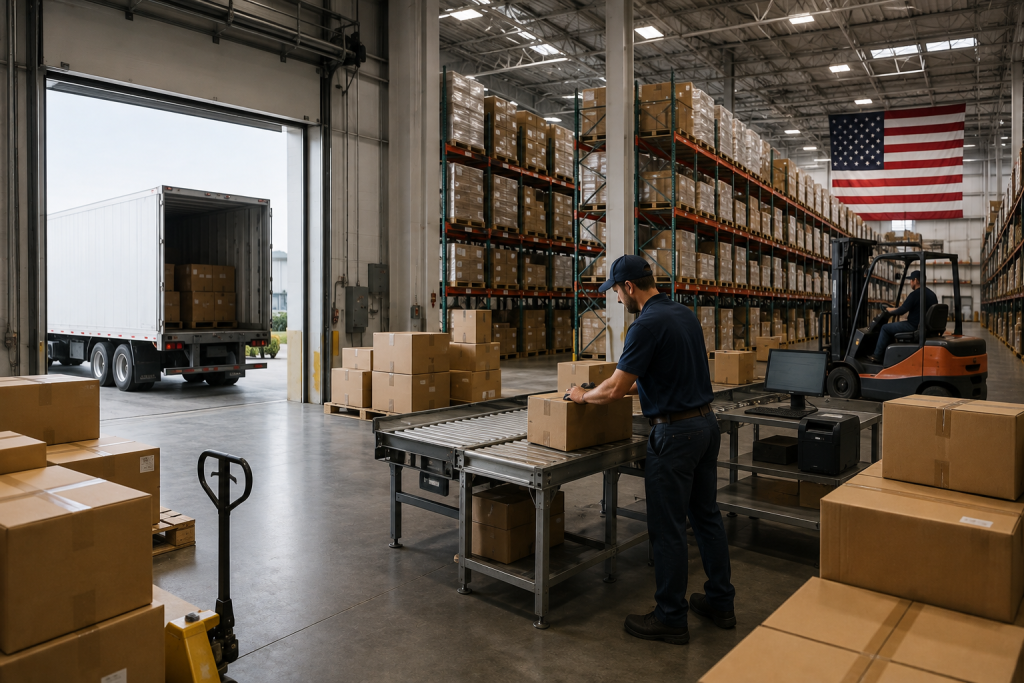
The simplest physical model keeps inventory mainly in one warehouse or fulfillment center.
That facility can serve several regions and sales channels. A company selling through its own website and online marketplaces, for example, could fulfill all of those orders from the same stock location rather than reserving separate warehouse inventory for each channel.
This arrangement can make stock easier to see and control because the business has one main physical inventory location.
It may also reduce duplicated inventory holdings and the need to operate warehouse space at every distribution point.
There is a trade-off. One centralized facility may be farther from some customers, which can affect outbound transportation cost and delivery time.
ShipBob makes the same distinction when comparing centralized and decentralized models. Fewer facilities can reduce storage-related costs, while regional fulfillment centers may put inventory closer to customers and reduce some shipping costs and transit times.
The warehouse decision therefore cannot be based on inventory cost alone.
Decentralized Pooling With Centralized Inventory Management
Inventory can also be distributed across several warehouses.
Under this model, each facility acts as a smaller inventory pool serving multiple cities, regions, or sales channels. A centralized inventory management system tracks stock across the network.
Accurate inventory data is critical here.
The company needs to know how much inventory is available and where it is physically located. If that information is delayed or incorrect, several sales channels may attempt to allocate the same remaining units.
A decentralized model can keep products closer to customers without creating completely isolated inventories for every channel.
It does, however, require tighter coordination between warehouses, sales systems, and order management.
Benefits of Inventory Pooling
Inventory pooling is mainly used to address two related problems: holding more inventory than necessary and still experiencing shortages in individual locations or channels.
The results vary by network and demand pattern, so the benefits should be treated as potential improvements rather than automatic outcomes.
Lower Inventory and Holding Costs
Businesses keep safety stock because demand does not always match the forecast.
When warehouses or sales channels operate independently, each may maintain its own buffer for the same product. Across a large network, those separate buffers can add up to a substantial amount of inventory.
Pooling demand can reduce some of that duplication.
Higher-than-expected demand in one part of the network may be partly offset by lower demand elsewhere. A shared stock supply can serve both rather than requiring every location to protect itself independently against demand variation.
This can reduce the aggregate amount of inventory required in some situations and leave less capital tied up in stock.
Physical centralization can also reduce warehouse requirements when a company is able to serve several distribution points from fewer facilities.
The related concept is known as risk pooling. Academic research on inventory pooling examines how combining demand and allowing inventory to be shared can affect safety stock and total inventory costs.
The effect is not identical under every demand pattern. The 2021 study by Rojas, Wanke, Bravo, and Tan modeled hospital warehouse inventory under different demand distributions and compared pooling and transshipment arrangements with a system without consolidation. The results varied according to characteristics of demand.
So the amount of inventory that can actually be reduced needs to be calculated from the company’s own data.
Better Stock Availability Across Channels
Pooling can make existing inventory easier to use.
Suppose a company has 300 units of one product divided equally among three sales channels. Each channel receives 100 units.
Channel A receives orders for 120 units, Channel B for 80, and Channel C for 60.
The company has enough total stock to fulfill all 260 orders. But if those original allocations are fixed, Channel A still runs out of stock.
A shared pool changes that situation. Units that are not required by Channels B and C can remain available for orders arriving through Channel A.
This does not mean pooling prevents every stockout. If total demand exceeds the inventory in the pool, there will still be a shortage.
What it can reduce are stockouts caused by available inventory being tied to another location or sales channel.
That is especially relevant for businesses selling the same SKUs through several channels where demand can shift quickly between them.
Less Duplicate Safety Stock
Safety stock is intended to protect a business against uncertainty.
If five locations plan independently, each one may keep its own buffer. Pooling can allow some of that uncertainty to be managed across the combined demand rather than separately at each point.
The company may therefore be able to maintain an acceptable level of product availability without simply adding together every location’s previous safety-stock requirement.
The size of that reduction is not fixed.
The academic study used for this article examined different demand distributions and found that the cost effects of pooling and regular transshipment changed according to statistical characteristics such as skewness and kurtosis.
That matters because two businesses with the same number of warehouses can get very different results from pooling.
Demand history has to be examined before reducing safety inventory.
More Flexible Inventory Allocation Across Sales Channels
Multichannel selling creates another problem: several platforms may be selling the same SKU at the same time.
If inventory is separated by channel, companies may have to decide in advance how many units belong to the website, marketplace, store network, or wholesale operation.
Those allocations can quickly become outdated when demand changes.
Pooling allows channels to draw from shared available stock instead.
The inventory records still need to update quickly when orders are placed, cancelled, returned, received, or adjusted. Otherwise, the business risks overselling inventory that has already been allocated somewhere else.
For a company adding new sales channels, a common inventory view can be easier to manage than creating another independent stock allocation every time a new channel is launched.
Inventory Pooling Challenges and Risks
Sharing inventory does not make inventory management automatic.
The business still has to decide where stock should be kept, how orders are allocated, when replenishment should take place, and what happens when several channels compete for limited inventory.
Weak inventory data can cause problems across the entire pooled system.
Inventory Management Becomes More Connected
A pooled system depends on accurate and timely inventory records.
Suppose the same 500 units are being sold through a website, two marketplaces, and a wholesale channel. If those systems do not update stock information quickly enough, more than one channel may attempt to sell the final available units.
The result can be overselling and backorders.
With several warehouses, there is another layer to manage. The company needs both a total inventory figure and an accurate record of where each unit is stored.
Knowing that 100 units exist somewhere in the network may not help if the fulfillment system cannot identify the warehouse that holds them or determine whether that location should serve a particular order.
ShipBob and WorldCraft both emphasize centralized inventory visibility and updated stock information when inventory is pooled across several fulfillment locations.
Demand Forecasting Still Matters
Pooling helps a company use available inventory across several sources of demand. It does not remove the need to forecast how much inventory will be required.
If the business consistently buys too little stock, sharing the shortage between several channels will not solve the problem.
Forecasting also affects where products should be placed in a decentralized network.
A company may have enough units overall but still face longer fulfillment times or higher shipping costs if most inventory is stored far from the customers placing orders.
Sales history, demand patterns, and changes across distribution points remain important inputs when planning replenishment.
Pooling can absorb some differences between expected and actual demand, but it cannot replace demand planning.
Setup and Operating Costs Can Increase
Inventory pooling is often discussed in connection with lower inventory or storage costs, but implementation can also create new expenses.
A business may need an inventory management system capable of tracking stock across sales channels and locations. Order allocation processes may also need to change.
Centralized pooling can require a facility large enough to receive and fulfill demand from several distribution points.
A decentralized approach creates a different cost structure. The company operates multiple fulfillment centers but can position products closer to customers.
This means that comparing one warehouse with several warehouses only by storage cost gives an incomplete picture.
Warehouse costs, inventory levels, order volume, shipping costs, and delivery times all need to be considered together.
A network that holds less stock is not necessarily cheaper if transportation expenses rise enough to offset the inventory savings.
Inventory Pooling Is Not Ideal for Every Product
The same inventory policy does not fit every SKU.
ShipBob specifically points to perishables as an example where pooling may be less suitable because additional storage time can increase spoilage risk.
Shelf life is only one consideration. Businesses also have to account for product demand and storage requirements when deciding what should be included in a shared pool.
A durable spare part with irregular demand may behave very differently from a fast-moving perishable product.
For that reason, pooling decisions can be made by product group rather than automatically applying the same setup to an entire catalog.
Inventory Pooling and Risk Pooling: What Is the Difference?
The terms inventory pooling and risk pooling are closely related, but they are not exactly the same.
Inventory pooling describes the operating model: multiple sources of demand are served from shared inventory rather than completely independent stock.
Risk pooling describes the inventory effect that can result from combining demand.
Demand is uncertain. When each location plans separately, every location may keep inventory to protect itself against its own variation in demand.
Combining those sources of demand can change the amount of safety stock required across the network.
This effect depends on the demand pattern rather than simply on the number of warehouses.
The research by Rojas, Wanke, Bravo, and Tan is useful here because it does not assume that every pooling setup produces the same savings. The study modeled pharmaceutical inventories in hospital warehouses and examined centralization and regular transshipment under different statistical demand scenarios.
Its simulations showed that the cost results depended on characteristics of the demand distributions. In the model used by the researchers, more negative skewness and higher kurtosis favored lower total costs to a greater extent under regular supply transshipment.
The study is specific to hospital inventory during the COVID-19 period, so its numerical results should not be transferred directly to an ecommerce or industrial warehouse.
The broader point is still relevant: demand characteristics affect how much value an inventory pooling model can provide.
How Inventory Pooling Affects Air and Ocean Freight Planning
Inventory pooling is mainly an inventory and warehousing decision, but replenishment still has to reach the warehouse network.
A centralized pool may concentrate inbound freight into fewer receiving locations. A decentralized model may require stock to be divided between several fulfillment centers.
Those arrangements create different transportation requirements.
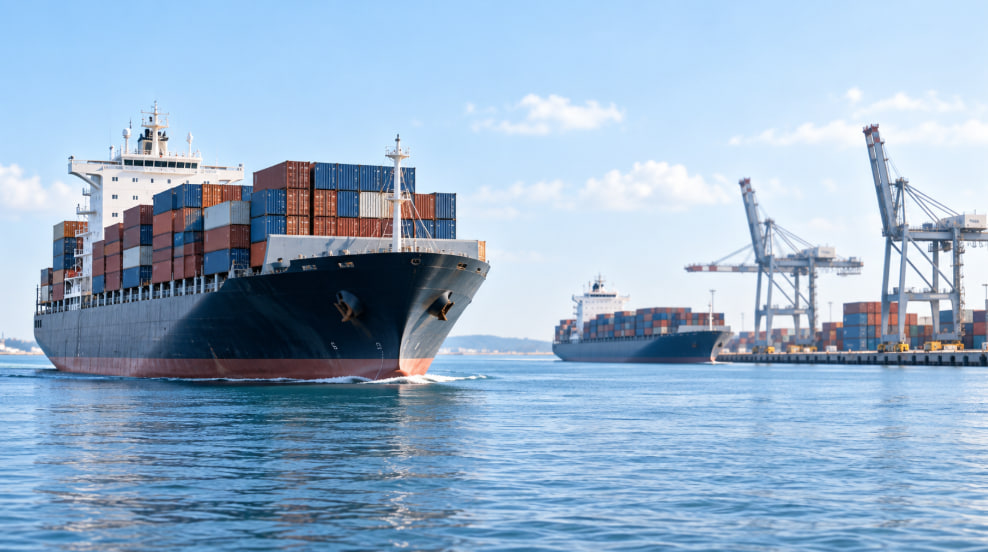
Ocean freight can be used for larger planned replenishment shipments. Depending on volume, cargo can move as Full Container Load (FCL) or Less than Container Load (LCL).
RAM International Shipping provides both FCL and LCL ocean freight. Its ocean freight services also include warehousing, receiving, sorting, distribution, and transloading.
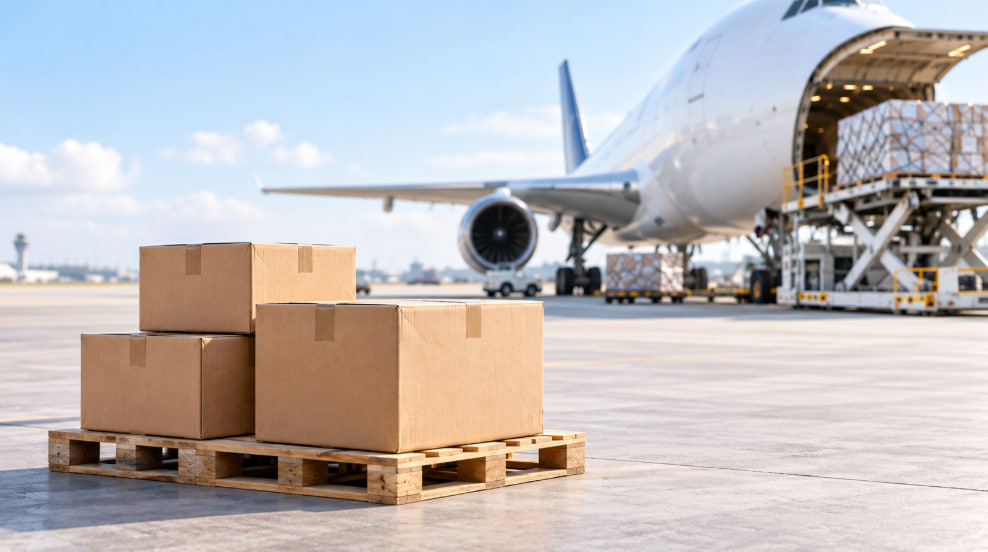
Air freight serves a different need where a shorter replenishment time is required. RAM’s current air freight services include standard, consolidated, specialized, and time-critical shipments, and the company specifically lists inventory restocking for retail and ecommerce among its air freight applications.
A company may therefore use ocean freight for planned inventory flows and air freight for certain products or periods where the required replenishment time is shorter.
The choice is not part of the definition of inventory pooling. It is a separate transportation decision that affects how quickly stock becomes available to the pool.
Lead time matters because an inventory model has to account for the time between placing a replenishment order and receiving usable stock.
A business reviewing its pooling strategy should therefore look at both inventory levels and inbound transportation. Shipment size, origin, delivery schedule, warehouse receiving capacity, and replenishment frequency all affect the result.
When Does Inventory Pooling Make Sense?
Inventory pooling becomes worth considering when several parts of a business hold or sell the same products independently.
This can happen when the same SKU is sold through multiple online channels, kept at several warehouses, or allocated separately between retail, wholesale, and direct-to-consumer operations.
The first question is whether stock is being duplicated.
If one channel repeatedly runs out while another holds unused units of the same SKU, fixed allocation may be contributing to the shortage.
A shared pool can make that available stock accessible to more orders.
Geography still matters.
Centralizing inventory in one facility can simplify stock management and reduce duplicated warehouse inventory, but it may increase the distance between products and some customers.
A decentralized pooling model can place stock closer to demand, but it requires accurate inventory visibility across multiple facilities.
The business also needs reliable inventory data.
If warehouses and sales channels cannot keep their stock records synchronized, sharing inventory between those systems can make availability harder to control.
Product characteristics should be considered as well. Demand pattern and shelf life can make some SKUs better candidates for pooling than others.
A company does not need to apply the same model to every product from the beginning. Starting with a defined group of SKUs makes it easier to compare how pooled inventory performs against the previous setup.
How to Plan an Inventory Pooling Strategy
Start by defining what will actually be pooled.
A business may be trying to share inventory between sales channels, several warehouses, geographic markets, or different customer groups. Each setup creates different inventory and fulfillment requirements.
Next, decide where the stock will physically sit.
A common inventory view does not require every product to be moved into one building. Centralized and decentralized pooling are both possible.
Order allocation also needs clear rules.
When stock becomes limited, the company needs to know which location or channel should receive the remaining inventory. The allocation method has to match the way the business fulfills orders.
Replenishment should then be reviewed using the combined demand.
Reorder levels that were set when every warehouse or channel operated independently may need to be reassessed after demand is pooled.
The results should be measured against the problems the company was trying to solve.
Useful measures include total inventory held, stock availability, stockouts and backorders, warehousing costs, shipping costs, and order fulfillment time. ShipBob’s comparison of centralized and decentralized models shows why these measures need to be reviewed together: reducing storage locations may lower one set of costs while changing transportation cost and delivery speed.
The goal is not simply to reduce the number of units in stock.
The inventory model still has to provide enough product availability for the orders the business expects to fulfill.
Inventory Pooling FAQs
Can Inventory Pooling Prevent Stockouts?
Inventory pooling can reduce some stockouts caused by inventory being separated between locations or sales channels.
If one channel has higher demand while another has unused stock, a shared pool can make those units available to the channel that needs them.
It cannot prevent every shortage. If total demand is greater than the stock available in the pool, the business can still run out.
Does Inventory Pooling Mean Using One Warehouse?
No.
Centralized pooling may use a single warehouse, but decentralized pooling can use several fulfillment centers with centralized inventory management.
In a decentralized setup, each location can act as a smaller pool while the company maintains visibility of stock across the wider network.
What Is Risk Pooling in Inventory Management?
Risk pooling refers to managing demand uncertainty across combined inventory rather than keeping independent buffers for every source of demand.
It can reduce duplicated safety stock in some inventory networks, but the amount of benefit depends on demand characteristics and the way the pooling system is structured.
Is Inventory Pooling Suitable for Every Product?
No.
Products do not all have the same demand patterns or shelf lives. ShipBob gives perishables as an example of goods that may be less suitable for pooling because of the risk of spoilage.
Businesses should evaluate products before applying the same inventory model across an entire catalog.
Can Air and Ocean Freight Both Be Used With Pooled Inventory?
Yes.
Inventory pooling determines how stock is shared and managed. It does not require a specific freight mode.
Ocean freight, air freight, ground transportation, or a combination of modes can be used to replenish inventory depending on shipment volume, timing, origin, destination, and cargo requirements.
Inventory Pooling as Part of a Wider Logistics Strategy
Inventory pooling affects more than the number of products sitting in a warehouse.
It changes how stock is allocated, how much safety inventory may be required, where goods are stored, and how replenishment is planned.
A centralized model can reduce duplicated inventory and warehouse requirements but place some stock farther from customers. A decentralized model can improve geographic coverage while requiring more facilities and closer control of inventory data.
Neither structure is automatically better.
The useful option depends on the company’s demand, products, sales channels, warehouse network, and transportation requirements.
Inbound freight is part of that calculation for businesses importing or distributing goods. Ocean freight can handle larger planned replenishment shipments, while air freight can provide shorter transit for time-sensitive restocking. Receiving, warehousing, transloading, and distribution determine what happens to that stock after it reaches the logistics network.
RAM International Shipping provides air and ocean freight together with warehousing and distribution services. Transportation options can be reviewed according to shipment volume, origin, destination, frequency, and required delivery schedule.
Inventory pooling can reduce duplicated stock and make existing inventory available across more sources of demand. Whether it delivers those benefits depends on demand patterns, inventory visibility, warehouse design, and the way replenishment is managed.